Music studio policies: the nine-part handbook every private teacher needs
A complete set of music studio policies covers nine areas: tuition and billing cycle, cancellation and no-show, make-up lessons, teacher absence, the holiday calendar, late payment, withdrawal notice, recital expectations, and communication norms. Write all nine, put them in one document, and have every family sign it at enrollment. The skeleton is below.
The short version
- Nine sections, one document. Scattered rules in old emails aren't a policy. A single signed handbook is.
- Two of the nine do most of the work. The cancellation window and the withdrawal notice period are where the money leaks.
- The most-skipped policy is the cheapest to write. Of seven published studio handbooks we read, exactly one spelled out communication norms and response times.
- Signature at enrollment beats a link on your website. No signature, no enrollment.
- Update it once a year, in writing, 60 days before it takes effect. Mid-year policy changes are what start arguments.
What we found in seven published studio handbooks
Before writing your own, it helps to see what working studios actually publish. We read seven public policy pages from private studios on September 15, 2026 and checked each against the nine sections.
| Policy section | Studios covering it (of seven) | Range found |
|---|---|---|
| Tuition and billing cycle | 7 | Monthly flat tuition dominates |
| Cancellation and no-show | 6 name a notice window | 6-hour to 48-hour notice |
| Make-up lessons and credits | 7 | Caps and expiry are the norm |
| Teacher absence and substitutes | 5 (1 partial) | Substitute, credit, or reschedule |
| Holiday and break calendar | 1 (3 link a separate calendar) | Dates usually live outside the policy |
| Late payment and fees | 4 | $20 to $55, from the due date to the 15th |
| Withdrawal and notice period | 7 | 30 days, one month, or a monthly cutoff date |
| Recital and performance expectations | 5 (2 partial) | Mostly optional participation |
| Communication norms and response times | 1 | Rarely written down |
Two patterns matter. Everyone writes the money and the exit; almost nobody writes the calendar or the communication rules — and those two omissions are what generate the "I texted you on Sunday night" conversations.
The notice windows themselves cluster tightly:
| Studio (public policy page) | Cancellation notice | Withdrawal notice |
|---|---|---|
| The Piano Place (UT) | 24 hours | By the 25th of the month |
| Opus 1 Music Studio | 24 hours | By the 15th of the month |
| Plumrose Piano Studio | 48 hours | By the 15th of the month |
| Mattix Music Studio | 24 hours | 30 days, written |
| Julia Piano Studio | 24 hours (3 for illness) | One month |
| Play! Piano Studio | 6 hours | End of semester |
| Armstead Music Studio | Not stated | 30 days, written |
Four of the six that name a window use 24 hours. That's not a legal standard, and it isn't a survey of the profession. It's seven studios, and it tells you 24 hours is unremarkable to families rather than aggressive.
Armstead is the useful outlier. It never states a cancellation deadline, because make-ups only ever happen on the first Friday of the month. A fixed make-up slot is the one setup that doesn't need a window. If yours isn't fixed, you need one.
A note before you copy anything. Everything below is a template, not legal advice. Contract and consumer-protection law varies by state, and nothing here guarantees a clause is enforceable where you teach. Have a local attorney read your final handbook before you ask anyone to sign it.
The nine music studio policies, with fill-in-the-blank language
Copy this whole block into a document, fill in every bracket, and delete the notes in parentheses. Aim for two pages. A six-page handbook doesn't get read, and an unread policy is a policy you can't point at later.
1. Tuition and billing cycle
The decision: are you billing per lesson, monthly, or by term? Monthly is steadier for you and more predictable for the family, and it's what most of the studios above use.
If you skip it: you spend the last three days of every month reconstructing who owed what.
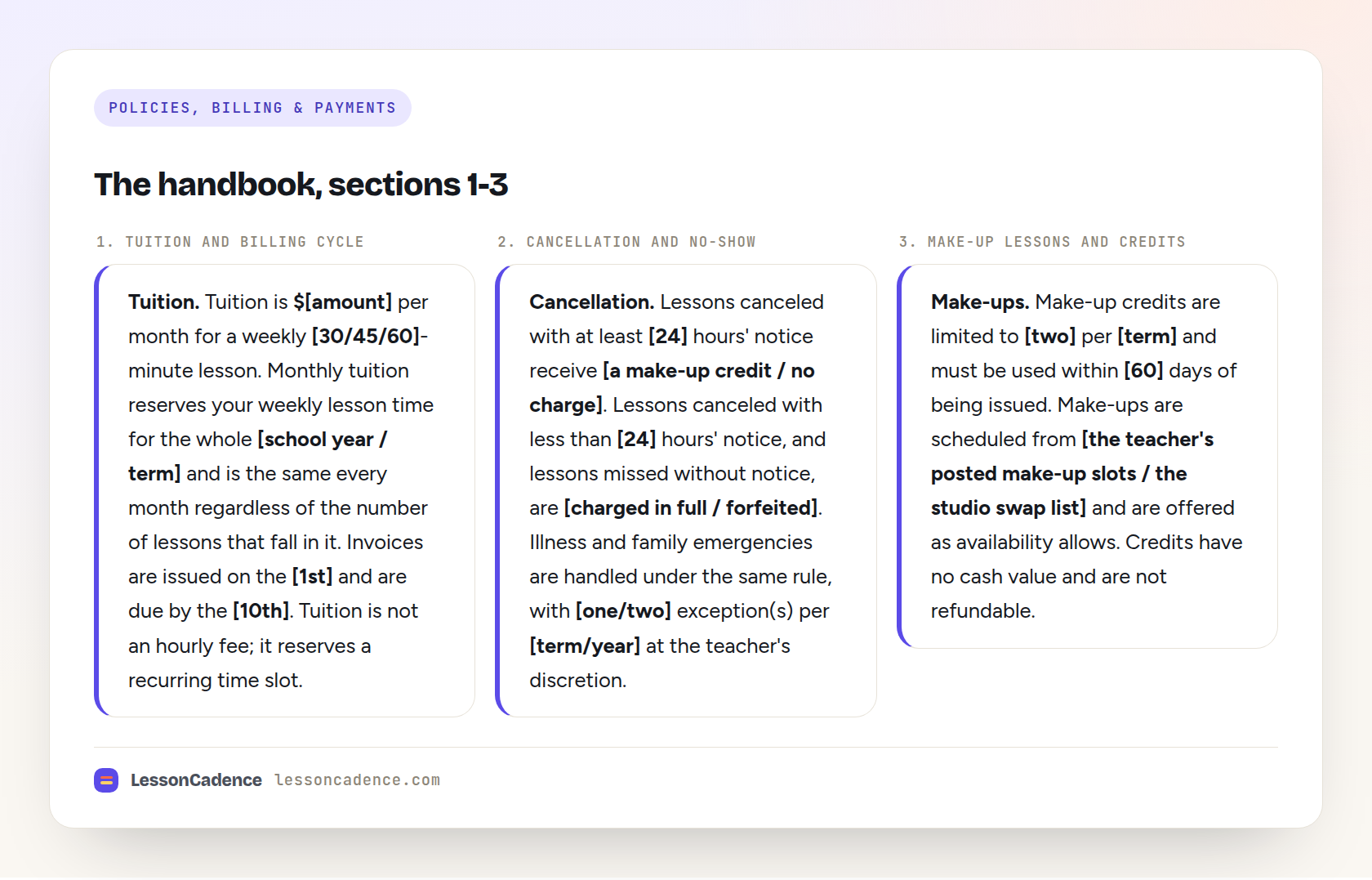
Tuition. Tuition is $[amount] per month for a weekly [30/45/60]-minute lesson. Monthly tuition reserves your weekly lesson time for the whole [school year / term] and is the same every month regardless of the number of lessons that fall in it. Invoices are issued on the [1st] and are due by the [10th]. Tuition is not an hourly fee; it reserves a recurring time slot.
That last sentence is the one that ends arguments about five-Monday months. Say it in the handbook, not in a text at 9pm.
2. Cancellation and no-show
The decision: the notice window, and what happens to the money — charged in full, banked as a credit, or forfeited. Those are the only two decisions that matter, and picking them is a whole article on its own: the 24-hour cancellation policy, decision by decision walks through all three money models with the language for each.
If you skip it: every late cancel becomes a negotiation, and you lose the ones you're too tired to have.
Cancellation. Lessons canceled with at least [24] hours' notice receive [a make-up credit / no charge]. Lessons canceled with less than [24] hours' notice, and lessons missed without notice, are [charged in full / forfeited]. Illness and family emergencies are handled under the same rule, with [one/two] exception(s) per [term/year] at the teacher's discretion.
Write the carve-out into the policy. A rule with a named exception gets enforced; a rule with unspoken exceptions gets eroded. (This is the moment most teachers realize the policy is only as good as their memory of it — LessonCadence checks the studio's window at the point of reschedule and applies the charge or the credit automatically, which is the same job a well-kept notebook does.)
3. Make-up lessons and credits
The decision: how many make-ups exist per term, and when they expire. Unlimited make-ups are the single most expensive sentence in a handbook.
If you skip it: you teach Saturday mornings for free.
Make-ups. Make-up credits are limited to [two] per [term] and must be used within [60] days of being issued. Make-ups are scheduled from [the teacher's posted make-up slots / the studio swap list] and are offered as availability allows. Credits have no cash value and are not refundable.
The cap and the expiry are what make this survivable. Plumrose Piano Studio, for example, publishes a limit of three credits per 90-day period expiring after six months — a real, working example of the shape. If you want the full comparison of make-up models and a ledger layout you can keep in a spreadsheet, see a make-up policy that's fair and doesn't cost you money. (LessonCadence keeps that ledger automatically, but a spreadsheet is genuinely fine at 20 students.)
4. Teacher absence and substitutes
The decision: when you cancel, does the family get a credit, a substitute, or a reschedule? Five of the seven studios we read address this. Families notice when it's missing.
If you skip it: you look like you have one rule for them and another for you.
Teacher absence. When I must cancel a lesson, you will receive [a make-up lesson at a mutually agreed time / a credit toward the following month's tuition]. Credits for teacher-canceled lessons [do not expire]. If I am unavailable for an extended period, I will arrange a qualified substitute teacher and notify you in advance.
Sick weeks, conference weeks, and your own family emergencies all live here. A substitute and coverage policy goes deeper on finding and briefing a sub before you need one.
5. Holiday and break calendar
The decision: which weeks you don't teach, and whether tuition still runs during them. This is the most-skipped section in our survey — one of the seven publishes actual dates, and three more just link to a calendar — and it's the easiest one to write.
If you skip it: you field the same six emails every November.
Studio calendar. The studio follows the [district name] school calendar for major breaks. The studio is closed for [list: Thanksgiving week, the last two weeks of December, spring break]. These closures are already reflected in monthly tuition; no credit is issued and no lesson is owed for a scheduled closure. The full-year calendar is attached and posted at [URL].
Attach the dated calendar as a separate page so you can reissue it each year without reprinting the handbook. Holiday lesson scheduling covers how to keep December revenue steady without teaching on the 26th.
6. Late payment and fees
The decision: the grace period and the fee. Only four of the seven studios charge a late fee at all; those that do charge $20 to $55, triggered anywhere from the due date to the 15th.
If you skip it: payment drifts later every month until you're financing your students' Decembers.
Late payment. A late fee of $[20] is added to any balance unpaid [10] days after the due date. Lessons may be suspended when an account is [30] days past due, and the reserved lesson time may be released to another student. Accounts on auto-pay are not subject to late fees.
The fee's job is to change the payment date, not to earn money. Set it high enough to notice and low enough to feel fair, then apply it every single time.
7. Withdrawal and notice period
The decision: how much notice a family owes before leaving. Thirty days or a monthly cutoff date are both common, and both do the same thing: they give you time to fill the slot.
If you skip it: a student quits on the 2nd and you carry an empty slot for six weeks.
Withdrawal. To discontinue lessons, please provide [30 days' / until the 15th of the month] written notice by [email to address]. Tuition for the notice period is due in full whether or not the lessons are attended. The reserved lesson time is released at the end of the notice period.
Written notice by email, not a text and not a conversation at the door. Put the address in the handbook.
8. Recital and performance expectations
The decision: is participation expected or optional, and who pays for what. Five of the seven spell this out, most of them making participation optional.
If you skip it: you plan a recital in March and discover in April that four families thought it was optional.
Performances. The studio holds [two] recitals per year, in [months]. Participation is [expected / encouraged but optional]. A performance fee of $[amount] per student covers [venue, programs, accompanist] and is [non-refundable] once registered. Registration closes [four] weeks before the event.
9. Communication norms and response times
The decision: which channel, and how fast you answer. Only one of the seven handbooks we read says this out loud — it answers Monday through Thursday, 10am to 5pm — which is why this is the most valuable section in your document.
If you skip it: your evenings belong to whoever texts last.
Communication. Studio business — scheduling, billing, and questions about lessons — goes to [email address]. I reply within [one business day], Monday through [Friday]. For a same-day cancellation only, text [number]. I do not respond to studio messages after [7pm] or on [Sundays].
Writing your working hours down is not rudeness. It's the same information a dentist's office prints on the door.
What the handbook is actually protecting
Here's an illustrative studio: 25 students, $32 per weekly 30-minute lesson, 36 teaching weeks a year.
Late cancels. One unrecovered late cancel a week across the year is 36 × $32 = $1,152.
No-notice withdrawals. Say four students leave mid-month each year. A 30-day notice clause converts each of those into roughly one more billed month: 4 lessons × $32 = $128 per student, or $512.
Combined: $1,664 a year, which is 52 lessons — about a month and a half of teaching. That's what the two paragraphs in sections 2 and 7 are worth. The handbook is not bureaucracy. It's the highest-paid hour of writing you'll do this year.
How to distribute it and get it signed
A policy nobody signed is a suggestion. Three rules:
- Send it before the first lesson, not after. It goes in the enrollment packet with the calendar and the intake form. The studio enrollment agreement is the document that carries it.
- Get a signature, digital or paper. Name, date, and a checkbox saying they read the cancellation and withdrawal sections specifically. Store it where you can find it in 18 months.
- Re-sign every year. Not because last year's signature expired, but because re-signing is how you introduce this year's changes without a separate confrontation.
For existing families who have never signed anything, don't backdate. Send the handbook with a start date at the beginning of the next term and ask for a signature by a named deadline.
How to update it annually without renegotiating with everyone
Pick a date — most studios use the end of the school year — and change the handbook once, then leave it alone for 12 months. The Louisiana Music Teachers Association's convention handout on studio policy puts the cadence plainly: a good policy "is the foundation of your business and should be communicated and signed annually," and you should "revise and send a copy of your policy at registration every year."
The mechanics that keep it calm:
- Give 60 days' notice before a new version takes effect. Rate changes and policy changes in the same letter, once a year.
- Show what changed. A three-line "what's new this year" at the top of the email. Hiding a change is how you lose trust you can't buy back.
- Never change a policy mid-term unless it's in the family's favor.
When a family pushes back
Most pushback isn't about the rule. It's about being surprised by the rule. Two scripts:
When they object to the policy at enrollment:
"That's a fair question. The 24-hour window is there so I can offer the slot to someone else, since your tuition is reserving that time whether or not it's used. I hold two make-up credits a term for exactly the situations you're describing. Does that work for your family?"
When they've broken it and want an exception:
"I've credited this one as a courtesy since it's the first time — I've noted it so we're both clear. Going forward the 24-hour rule applies as written, because the only way it's fair to everyone is if it's the same for everyone."
Grant the first exception, name it as an exception, and hold the second. Inconsistent enforcement is worse than a weak policy, because it teaches families that the real rule is how tired you sound.
The Louisiana handout takes a harder line than that — it "strongly suggested that you make few or no exceptions to your policy," and warns that exceptions weaken it both in fairness to other families and legally. The middle ground is the one written into section 2 above: put the exception in the policy, with a number, so granting it is the rule working rather than the rule bending.
What the associations publish
Short answer: guidance, not model language. MTNA runs a public Business Resources Library with a "Studio Policies" keyword tag covering 13 resources and a Legal category, but its own document "Creating and Improving Studio Policies" sits on a members-only path that returns a 404 to the public, and its studio-policy page offers articles rather than a downloadable template.
At the state level, the Louisiana Music Teachers Association hosts a public convention handout, "Establishing an Effective Studio Policy." It lists the essential elements as "tuition and other financial arrangements (state number of lessons in term, how payment is to be made, studio fees, late fees, music billing, entry fees)," "required materials," "lesson length, type and duration," "attendance policies, including make-ups, refunds, credits, cancellations," and "termination of lessons."
That maps onto sections 1, 2, 3, 6 and 7 here. Notably, it files communication under optional elements — alongside parking and late pick-up — which is a fair explanation of why the section is the one nobody writes. The Washington State Music Teachers Association sells a recorded studio-policy workshop rather than publishing a template.
So there is no free, official model policy text to copy. That's the gap this skeleton fills — and the reason to have your own attorney look at the final version.
Frequently asked questions
What should a music studio policy include?
At minimum: tuition and billing cycle, cancellation and no-show, make-up lessons, teacher absence, holiday calendar, late payment, withdrawal notice, recital expectations, and communication norms. All seven studio handbooks we surveyed covered tuition, make-ups and withdrawal. The commonly missing pieces are the dated calendar and the communication rules.
Do music teachers need a contract, or is a policy enough?
A signed studio policy functions as the agreement between you and the family in most private studios, which is why signature at enrollment matters more than the document's title. Whether your particular wording is enforceable depends on your state's law. Ask a local attorney before you rely on any clause.
How do I get parents to sign my studio policy?
Send it with the enrollment packet before the first lesson, ask for a signature by a named date, and make enrollment conditional on it. For existing families, introduce the handbook with a start date at the beginning of the next term rather than backdating it.
How often should I update my studio policy?
Once a year, with at least 60 days' notice before the new version takes effect, and never mid-term unless the change favors the family. Bundle the rate change and the policy change into the same annual letter so families absorb one update instead of three.
What if a parent refuses to sign the studio policy?
Treat it as a question, not a refusal — usually one clause is the problem. Ask which section concerns them and explain the reason behind it. If they still won't sign, don't enroll them; a family that won't agree to the terms in September will not agree to them in February either.
Sources
- The Piano Place — Policies & Guidelines: https://thepianoplaceutah.com/policies/ (checked 2026-09-15; 24-hour cancellation, $20 late fee at 10 days overdue, withdrawal by the 25th, make-up credits valid 30 days with two pending maximum)
- Opus 1 Music Studio — Private Lessons Studio Policies: https://opus1musicstudio.com/studiopolicies/ (checked 2026-09-15; 24-hour cancellation, $25 late fee after the 10th for non-auto-pay members, withdrawal by the 15th, three pending credits maximum)
- Plumrose Piano Studio — Studio Policy: https://plumrosepiano.com/studio-policy (checked 2026-09-15; 48-hour cancellation, $55 late fee if not received by the 15th, three make-up credits per 90-day period expiring after six months)
- Mattix Music Studio — Studio Policy: https://mattixmusic.com/policy/ (checked 2026-09-15; 24-hour cancellation, one make-up per semester, 30-day written withdrawal notice, no late fee — returned-check fees only)
- Julia Piano Studio — Policies: https://www.juliapiano.com/policies (checked 2026-09-15; 24-hour cancellation and three hours for illness, three excused make-ups per school year, one month's withdrawal notice, no late fee)
- Play! Piano Studio — Studio Policy & Handbook: https://www.piano.lynnthibeau.com/studio-info-policy (checked 2026-09-15; 6-hour reschedule window, no lessons carried into a new week or semester, published break calendar, replies Monday–Thursday 10am–5pm)
- Armstead Music Studio — Studio Policies: https://armsteadmusicstudio.com/studio-policies (checked 2026-09-15; no stated cancellation window, make-ups only on the first Friday of the month, $25 late fee on the due date, 30-day written withdrawal notice)
- Music Teachers National Association — Business Resources Library: https://www.mtna.org/resources/ (checked 2026-09-15; public library, "Studio Policies" keyword tag lists 13 resources, Legal category present)
- Music Teachers National Association — Studio Policies/Documents: https://www.mtna.org/MTNA/Business_Resources/Studio_Resources/Policy_Docs/Policy.aspx (checked 2026-09-15; articles only, no downloadable model policy)
- Music Teachers National Association — Creating and Improving Studio Policies: https://www.mtna.org/downloads/MembersOnly/22161_StudioPolicies.pdf (checked 2026-09-15; members-only path, returns a 404 to the public)
- Louisiana Music Teachers Association — Establishing an Effective Studio Policy (convention handout): https://lmta.org/wp-content/uploads/2020/07/ESTABLISHING-AN-EFFECTIVESTUDIO-POLICY.pdf (checked 2026-09-15; source of the essential-elements list and the quoted lines on annual signing, registration and exceptions)
- Washington State Music Teachers Association — Studio Policy Workshop: https://wamta.gumroad.com/l/studiopolicy (checked 2026-09-15; paid recorded workshop, not a template)
- Music Studio Startup — 5 Points to Cover in Your Music Studio Policy: https://www.musicstudiostartup.com/a-simple-studio-policy-5-points-to-include/ (checked 2026-09-15; SERP comparison)
- Musician & Co. — Free Music Studio Policies Template: https://musicianandcompany.com/resources/p/studio-policies (checked 2026-09-15; SERP comparison, four-part framework)
Written for teachers by the LessonCadence team. Last reviewed: 2026-09-15.