How to invoice music students every month
Send one invoice per family on the same date each month, for the month ahead. Include the lesson dates, the lesson count, any credits applied, the total, a due date, and a payment link. Then reconcile make-ups and cancellations onto the next invoice instead of rewriting this one.
The short version of how to invoice music students without the monthly chase:
- Bill in advance. Tuition for October goes out in late September. Money before lessons, not after.
- Pick one billing date and one due date and never move them. Same date every month builds the habit.
- Put six things on the invoice: lesson dates, lesson count, credits applied, total, due date, payment link.
- Never edit a sent invoice. Changes go on next month's invoice as a line item.
- Run a four-message reminder sequence: three days before, day of, three days after, seven days after.
The invoice itself is the easy part. Any free template will produce a decent-looking one. What actually fixes your billing is the cycle — a fixed date, a fixed direction, and a rule for what happens when a lesson gets missed.
Bill in advance, not in arrears
Billing in arrears means you teach four lessons, then ask to be paid for them. It feels polite. It costs you twice.
First, cash flow. You are financing your students' lessons for a month, and if a family leaves mid-month you are chasing money for lessons already taught.
Second, retention. A family that has already paid for October shows up in October. A family that owes for September is making a fresh decision every week about whether to keep going.
Billing in advance flips both. The payment is a commitment, made before the value is delivered, which is how gyms, preschools, and every other recurring-service business operates.
The rule: tuition for a month is due before the first lesson of that month. Everything else in this article follows from that one decision.
If you are currently billing in arrears, don't try to switch in one month. That asks families to pay twice in four weeks. Announce the change six weeks out, then run one transition month where the arrears invoice and the first advance invoice are split across two due dates.
Pick your billing date, due date, and grace period
Three dates, decided once, written into your studio policy.
| Date | Suggested | Why |
|---|---|---|
| Billing date (invoice sent) | The 25th of the prior month | Lands before most families' month-end money runs out |
| Due date | The 1st | Unambiguous, easy to remember, matches rent and other monthly bills |
| Grace period ends | The 5th | Absorbs weekends, travel, and a card that expired quietly |
| Late fee applies | The 6th | Only after the grace period, and only if your policy says so |
Six days from invoice to due date is enough time for a parent to notice and act, and short enough that it doesn't drift. Avoid due dates that float. "Due within 7 days" means eight different due dates across your studio and eight different follow-up dates for you.
Put all four dates in your studio policy document and in the enrollment paperwork, so the first invoice is never the first time a family hears about them.
What goes on a music lesson invoice
Requirements for invoice contents vary by state and by whether you're a sole proprietor or an entity, so check locally rather than copying a template blindly. What follows is what parents expect to see, and what stops the "wait, what is this for?" email.
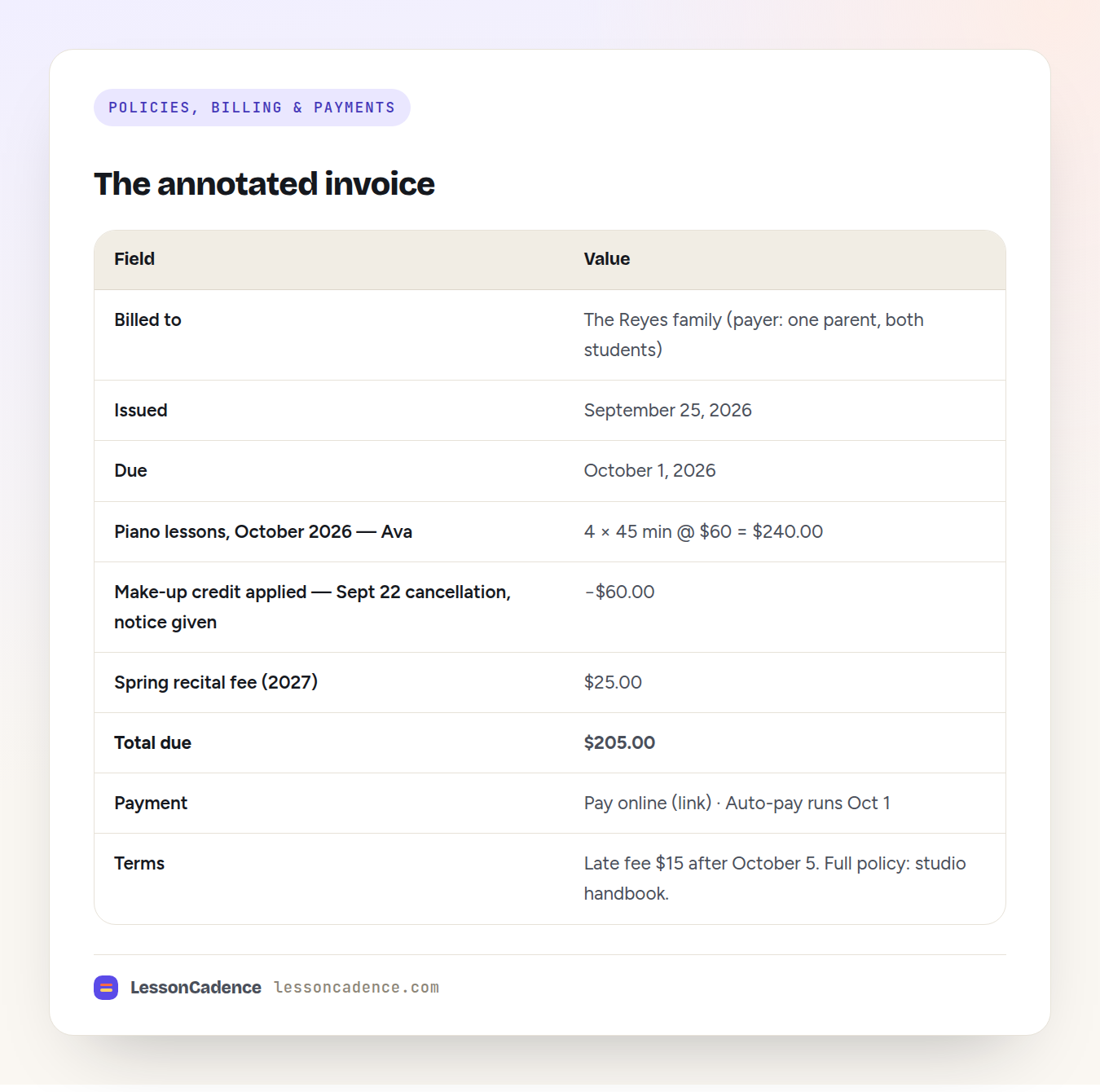
Here's an annotated sample. Names and studio are illustrative.
Maple Street Piano Studio — Invoice 2026-10-014
| Field | Value |
|---|---|
| Billed to | The Reyes family (payer: one parent, both students) |
| Issued | September 25, 2026 |
| Due | October 1, 2026 |
| Piano lessons, October 2026 — Ava | 4 × 45 min @ $60 = $240.00 |
| Make-up credit applied — Sept 22 cancellation, notice given | −$60.00 |
| Spring recital fee (2027) | $25.00 |
| Total due | $205.00 |
| Payment | Pay online (link) · Auto-pay runs Oct 1 |
| Terms | Late fee $15 after October 5. Full policy: studio handbook. |
What each part is doing:
- Lesson dates and count, not just a total. "October lessons — $240" invites an argument. "4 × 45 min @ $60" ends it.
- The credit shown as a line item. Applying a credit silently makes the total look wrong. Naming it makes you look organized.
- One invoice per family, not per student. Siblings belong on the same document under one payer. See sibling and family billing for how to lay that out.
- A due date, not a "thank you." The due date is the single most-read field on the page.
- The terms line. One sentence, referencing your policy. It should never be a surprise.
This sample bills by lesson count, which is the clearer format when a family is new or when credits are in play. On flat monthly tuition, the same line reads "Piano tuition, October 2026 (36-lesson year, payment 2 of 10) — $216.00," with the lesson dates listed underneath. Either way, the dates stay on the page.
Flat monthly tuition or per-lesson billing when the month has five weeks
This is where most monthly billing breaks. Some months have four of your teaching day, some have five, and the family's bill lurches around.
Take a Tuesday 4:00 student at $60. September 2026 has five Tuesdays; October 2026 has four. Per-lesson billing means a $300 invoice followed by a $240 invoice, a 20% swing that generates a question every single time.
Flat monthly tuition solves it. You set a school-year lesson count, multiply, and divide.
Worked example. Your studio calendar has 36 lessons between September and June. At $60 per lesson that's $2,160 for the year. Billed across 10 equal months, tuition is $216 per month, every month, regardless of whether that month holds four lessons or five.
Two things make this work:
- Publish the studio calendar with the 36 dates on it, before the first invoice. The number families need to see is 36 lessons for $2,160, not "$216 for four lessons" in a month where they counted four.
- Say "tuition," not "per lesson." Once the invoice says tuition for a term, the five-week month stops being a billing event.
Per-lesson billing is still the right call in two cases: adult students who book irregularly, and short-term prep work. For everyone on a weekly recurring slot, flat tuition is fewer questions and steadier income. If you want the mechanics of both side by side, see recurring invoices versus one-off invoices.
Reconcile make-ups and credits onto the next invoice
The rule that saves the most time: a sent invoice is final. You never reissue, never edit, never send a corrected version. Anything that happens after it goes out becomes a line item on the following month's invoice.
So a September 22 cancellation with proper notice becomes a −$60 credit line on the October invoice, which is exactly what the sample above shows.
Keep a running ledger per family with four columns: date, event, amount, and status (banked, applied, expired). At 20 students a spreadsheet handles this fine. What kills teachers is not the tracking. It's tracking in three places at once: a calendar, a text thread, and a memory of what you promised in the parking lot.
Credits work differently under flat tuition. On per-lesson billing, a banked make-up is a dollar amount that comes off the next invoice, as in the sample above. On flat monthly tuition it isn't — the family owes $216 in October whether or not they missed a lesson in September, because the $216 is one-tenth of a 36-lesson year. What they hold is a lesson to be rescheduled, not a discount.
Say which one you run, in writing, before anyone asks. Studios lose real money by publishing flat tuition and then handing out dollar credits when a parent pushes — that quietly converts the year's price into a variable one.
Two decisions to make before the credits pile up:
- Do credits expire? Most studios expire them at the end of the term or the school year. Without an expiry, you carry an open liability into next year.
- Are they refundable? Almost always no — credit toward future lessons, not cash back. Your make-up lesson policy is where this gets written down, not the invoice.
LessonCadence builds each month's invoice from actual attendance and applies banked credits automatically, which is the same job the spreadsheet does, without the reconciling step at 10pm on the 24th.
Send an email with a payment link, not a PDF attachment
A PDF attachment asks the parent to open a file, find their checkbook or their banking app, and remember to come back. A hosted invoice with a Pay now button asks them to tap once. The gap in collection speed between those two is not small.
Whatever you use, the payment method changes what you keep. Rates below are the published US rates on each processor's own page, checked September 30, 2026.
Worked example — the $205 October invoice above:
| Payment method | Published rate | Fee on $205 | You keep |
|---|---|---|---|
| Card (Stripe standard) | 2.9% + 30¢ | $6.25 | $198.75 |
| ACH bank debit (Stripe) | 0.8%, capped at $5 | $1.64 | $203.36 |
| PayPal invoice, paid by card | 2.99% + 49¢ | $6.62 | $198.38 |
| PayPal invoice, paid from a PayPal or Venmo balance | 3.49% + 49¢ | $7.64 | $197.36 |
PayPal split those last two rates in its September 1, 2026 schedule, and the parent chooses which one you get by choosing how to pay. You cannot control that, so budget for the higher one.
The spread between card and ACH is $4.61 on this one invoice. For a 20-student studio billing 10 months a year, that's 200 invoices and about $921 a year — roughly 15 lessons at $60, given away in 30-cent pieces.
That doesn't mean refuse cards. Card auto-pay collects far more reliably than a bank transfer a parent has to initiate. It means: offer ACH as the default for families who'll take it, keep card as the fallback, and stop treating processing fees as unavoidable weather.
The four-message reminder sequence
Four messages, sent on a schedule, replace the awkward monthly conversation. The tone escalates by exactly one notch each time.
| When | Message | Tone |
|---|---|---|
| 3 days before due | "October tuition is ready — $205, due Oct 1. Pay here." | Informational |
| Day of due | "Quick reminder: October tuition is due today." | Neutral |
| 3 days after | "October tuition is still open. The grace period ends Friday the 5th." | Names the deadline |
| 7 days after | "October tuition is now past due and a $15 late fee has been applied." | States what happened |
Three rules make this work. Send them on a schedule, not when you're annoyed. Never mention a family's balance in front of their child. And never negotiate over text — if a family needs a payment plan, that's a phone call, and the answer is yes.
LessonCadence sends this sequence and runs auto-pay on the due date, so the third and fourth messages mostly stop being needed. If you're doing it by hand, four calendar reminders on the 28th, 1st, 4th, and 8th will do the job.
For the actual wording — including the versions for a repeatedly late payer — see late cancellation and late payment email scripts.
Late fees: when to add one, and how to word it
A late fee is not a revenue stream. Its only job is to make paying on time slightly easier than paying late.
Keep it small and flat. Somewhere around $15 to $25 on a $200 invoice lands harder than a percentage, because it's a number rather than a formula. Apply it after the grace period, not the due date. Waive the first one for a family with a clean record; say plainly that you're waiving it once.
Policy language you can copy:
Tuition is due on the 1st of each month. A $15 late fee applies to balances unpaid after the 5th. Lessons may be paused for accounts more than 30 days past due. If you need a different payment schedule, contact me before the 1st — I'd rather arrange it than chase it.
The last sentence is the important one. Most late payments are a cash-flow problem, not a respect problem. Giving parents a door to knock on prevents the silence that turns into a dropped student. The full playbook for that lives in how to get paid on time.
The monthly routine: how to invoice music students in about 20 minutes
On the 24th or 25th, in one sitting:
- Open your calendar and confirm next month's lesson dates against the studio calendar.
- Note any credits banked this month and which family each belongs to.
- Generate invoices — one per family, flat tuition plus any line items.
- Apply credits as visible negative line items.
- Send, with the payment link in the body of the email.
- Set the four reminder dates.
- Close the laptop. Do not check who has paid until the 1st.
That last step is not a joke. Watching the inbox between the 25th and the 1st is where teachers burn the evening they were supposed to get back.
FAQ
How often should music teachers invoice students?
Monthly, billed in advance, is the standard for weekly recurring lessons. It's one invoice per family per month instead of four, it matches how parents budget, and it gives you a predictable date. Bill per lesson only for irregular adult students or short-term exam prep.
Should I charge per lesson or a flat monthly tuition?
Flat tuition, in almost every case. Take your school-year lesson count, multiply by your rate, divide by the number of billing months. A 36-lesson year at $60 is $2,160, or $216 a month over 10 months — the same figure whether the month holds four lessons or five.
What should a music lesson invoice include?
Your studio name and contact details, the family being billed, the invoice date and number, the lesson dates and count, the rate, any credits or fees as separate lines, the total, the due date, a payment link, and one line of terms. Requirements vary locally, so confirm what applies to your business.
What do I do when a parent doesn't pay?
Run the sequence: reminder three days before, on the due date, three days after, and seven days after with the late fee applied. If nothing lands by day 10, call rather than text. Most non-payment is a dead card or a missed email, and one phone call resolves it faster than four more messages.
How do I handle a month with five lessons?
If you bill flat monthly tuition, you don't — the fifth lesson is already inside the annual figure. If you bill per lesson, publish the studio calendar in advance so the five-lesson month is expected, and put the lesson count on every invoice so the higher total explains itself.
Sources
- Stripe — Pricing (US): 2.9% + 30¢ per successful domestic card charge; ACH Direct Debit 0.8% capped at $5.00. https://stripe.com/pricing (verified 2026-09-30)
- PayPal — Merchant fees (US), fee schedule last updated September 1, 2026: standard invoicing 3.49% + $0.49 when the payer uses PayPal, Venmo or guest checkout, and 2.99% + $0.49 for standard credit and debit cards; Pay by Bank 1% capped at $10. https://www.paypal.com/us/webapps/mpp/merchant-fees (verified 2026-09-30)
- Calendar dates for September and October 2026 (five Tuesdays in September, four in October) confirmed against the 2026 civil calendar (verified 2026-09-30)
Written for teachers by the LessonCadence team. Last reviewed: 2026-09-30.