A make-up lesson policy that doesn't cost you money
A workable make-up lesson policy sets three dials: a notice window, a cap on how many credits a student can hold, and an expiration date. Pick one of four models, write the cap into your handbook, and never reduce an invoice for a lesson you're also going to reteach. That last rule is where most of the money goes.
The short version
- Make-ups are a scheduling liability, not a courtesy. Every credit you bank is an hour you owe out of your own calendar later.
- The cost is in hours, not dollars. A 28-student studio giving unlimited make-ups spends about 50 hours a term on them.
- Three dials control your exposure: notice window (24 or 48 hours), cap (0 to 3 credits), and expiration (14 days to 6 months). Real published studio policies sit inside those ranges.
- A credit is a right to reschedule, never a right to a discount. Pick one. Doing both quietly doubles the cost of every absence.
- Track credits in a ledger with an expiry date and a status column, even if it's a spreadsheet.
What a make-up credit actually is
A make-up credit is a promise to deliver teaching time you have already been paid for. It is not a refund, not a discount, and not a prepaid lesson package.
That distinction sounds pedantic until a family asks you to knock $60 off the November invoice and schedule the make-up. Then it's the whole ball game.
Your cancellation policy decides whether a missed lesson earns a credit. Your make-up policy decides what happens to the credit after that. The two documents have to agree, or families will read whichever one favors them.
What unlimited make-ups cost in hours
Here is the calculation almost nobody runs. The numbers below are illustrative, but the structure is the point. Substitute your own.
Assumptions: 28 students, weekly 45-minute lessons at $60, a 15-week fall term, each student missing two lessons in the term, and eight minutes of messaging and rescheduling per make-up.
| Model | Make-ups taught | Teaching hours | Admin hours | Total hours/term |
|---|---|---|---|---|
| Unlimited make-ups | 56 | 42.0 | 7.5 | 49.5 |
| 1 credit per student, 24-hour notice, 30-day expiry | 24 | 18.0 | 3.2 | 21.2 |
The capped row assumes about 40% of absences land inside the notice window and earn nothing, and that roughly 15% of issued credits expire unclaimed. Both are conservative.
The gap is 28 hours a term. Across two terms that's about 57 hours a year, which is a week and a half of full-time work, taken out of your evenings and Saturdays.
Now look at the same 42 hours as capacity. Spread over 15 weeks, that's 2.8 hours a week — nearly four recurring 45-minute slots you can't sell, because make-ups are holding them. Count only three of those slots at $60 a week for 15 weeks and it's $2,700 a term, or $5,400 across the year.
Unlimited make-ups don't cost you a refund. They cost you the studio you could have had.
What real studios actually publish
Before you decide your own numbers, it helps to see the range. These are eight make-up policies published on real studio and community-music-school websites, checked September 16, 2026.
| Studio | Cap | Notice required | Credit expires |
|---|---|---|---|
| Libero Piano Studio | 1 per academic year, illness only | Swap list first | No credits issued |
| Piano Plus Teaching Studio | 1 per 12-week session | 24 hours | 30 days; forfeited June 30 |
| KU Community Music School | 2 per semester | 48 hours | Not specified |
| Opus 1 Music Studio | 3 pending at a time | 24 hours | 30 days after membership ends |
| Plumrose Piano Studio | 3 per 90 days | 48 hours | 6 months |
| Open Lid Piano Studio | Not specified | 24 hours | 14 days |
| Landrum Music Studio | Swap list only | n/a | n/a |
| Joy Morin Piano Studio | Discretionary, plus flex weeks | 24 hours requested | n/a |
Three things stand out. Nobody publishes a notice window shorter than 24 hours. Nobody caps above three credits. And four of the five studios that issue a trackable credit put a deadline on it, from 14 days to six months.
If you were worried a cap of two would look harsh, it doesn't. It sits in the middle of what working studios already post publicly.
The four models
| Model | Hours cost | Best for |
|---|---|---|
| No make-ups | Near zero | Full studios with a waitlist; annual tuition billing |
| Limited credits | Moderate, capped | Most solo studios; the default recommendation |
| Swap list | Near zero for you | Studios of 15+ students with engaged families |
| Flex week | Zero variable cost | Teachers who bill an annual tuition divided by 12 |
No make-ups. Tuition reserves a place in your schedule, and the reservation is what the family buys. This is only defensible if you say so in the enrollment agreement, up front, and if you honor teacher-initiated cancellations with a real make-up.
Limited credits. A student earns a credit when they cancel with notice, up to a cap, and the credit expires. This is the model that needs a ledger, and the one most teachers should pick.
Swap list. You publish a roster of enrolled families who have opted in to sharing contact details, and families trade lesson times with each other. Landrum Music Studio runs exactly this: the family arranges the swap, then emails the teacher to confirm. Your only job is confirming, which is the whole point.
Flex week. You bill an annual tuition divided into 12 equal payments and teach fewer weeks than the calendar has — the studio-business writer Wendy Stevens describes teaching 38 weeks a year and holding the remainder as flex. Absences absorb into the buffer instead of generating individual credits.
The swap list only works if you stay out of the negotiation. The moment you start texting three families to find a match, you have converted a zero-hour model into a high-hour one. Publish the list, state that arranging the swap is the family's job, and require an email confirmation to you before it counts.
Copy-paste make-up lesson policy language
Replace the bracketed values with your own, and put the result in your studio handbook alongside the other policies families sign. These are drafting starting points, not legal advice; if your state regulates prepaid instruction or your studio operates as an entity, have a local attorney read your enrollment agreement.
Model 1 — No make-ups
Tuition reserves your student's weekly lesson time for the full term. Lessons missed by the student are not credited, rescheduled, or refunded, for any reason. If I must cancel a lesson, I will reschedule it at a mutually workable time or credit it to your next invoice.
Model 2 — Limited credits
Lessons canceled with at least [24] hours' notice earn a make-up credit. A student may hold up to [2] open credits at one time; absences beyond that are not credited. Credits must be used within [30] days of the missed lesson and expire after that. Cancellations with less than [24] hours' notice, and no-shows, do not earn a credit. Make-up credits have no cash value and are not refundable.
Model 3 — Swap list
Families who opt in appear on the studio swap list with a name, lesson time, and email address. If you need to miss a lesson, contact another family directly and arrange a trade. Email me once both families agree, at least [24] hours before the earlier of the two lessons, and I will confirm the change. I do not arrange swaps on a family's behalf. Lessons missed without an arranged swap are not credited.
Model 4 — Flex week
Annual tuition covers [38] weeks of instruction, billed in 12 equal monthly payments. The studio calendar publishes scheduled breaks; the remaining weeks are held as flex time for illness, weather, and emergencies on either side. Individual missed lessons are absorbed by this buffer and are not separately credited or refunded.
The make-up credit ledger
If you issue credits, you need a record. At 20 students a spreadsheet is genuinely fine. Here is the layout.
| Column | What goes in it | Why it matters |
|---|---|---|
| Credit ID | MU-001, sequential | Lets you reference one credit in an email |
| Student / payer | Two columns; siblings share a payer | Credits belong to a student, invoices to a payer |
| Original date | Date of the missed lesson | Starts the expiry clock |
| Length | 30 / 45 / 60 minutes | Converts open credits into hours owed |
| Notice hours | Hours between the cancellation and the lesson | The eligibility test, in writing |
| Eligible | =IF(F2>=24,"Y","N") | Removes the judgment call |
| Expires | =D2+30 | The single most-skipped field |
| Status | Open / Scheduled / Used / Expired / Waived | Everything else depends on this |
| Make-up date | Filled when taught | Closes the loop |
| Invoice period | The cycle that already paid for it | Stops double-crediting |
Add one summary cell: =SUMIFS(Length,Status,"Open")/60. That gives you open credits in hours — your actual liability. If it reads 9.5 hours in October, you owe nine and a half hours of Saturdays.
Set a second cell to count open credits per student, =COUNTIFS(Student,B2,Status,"Open"), so the cap enforces itself before you say yes to a third one.
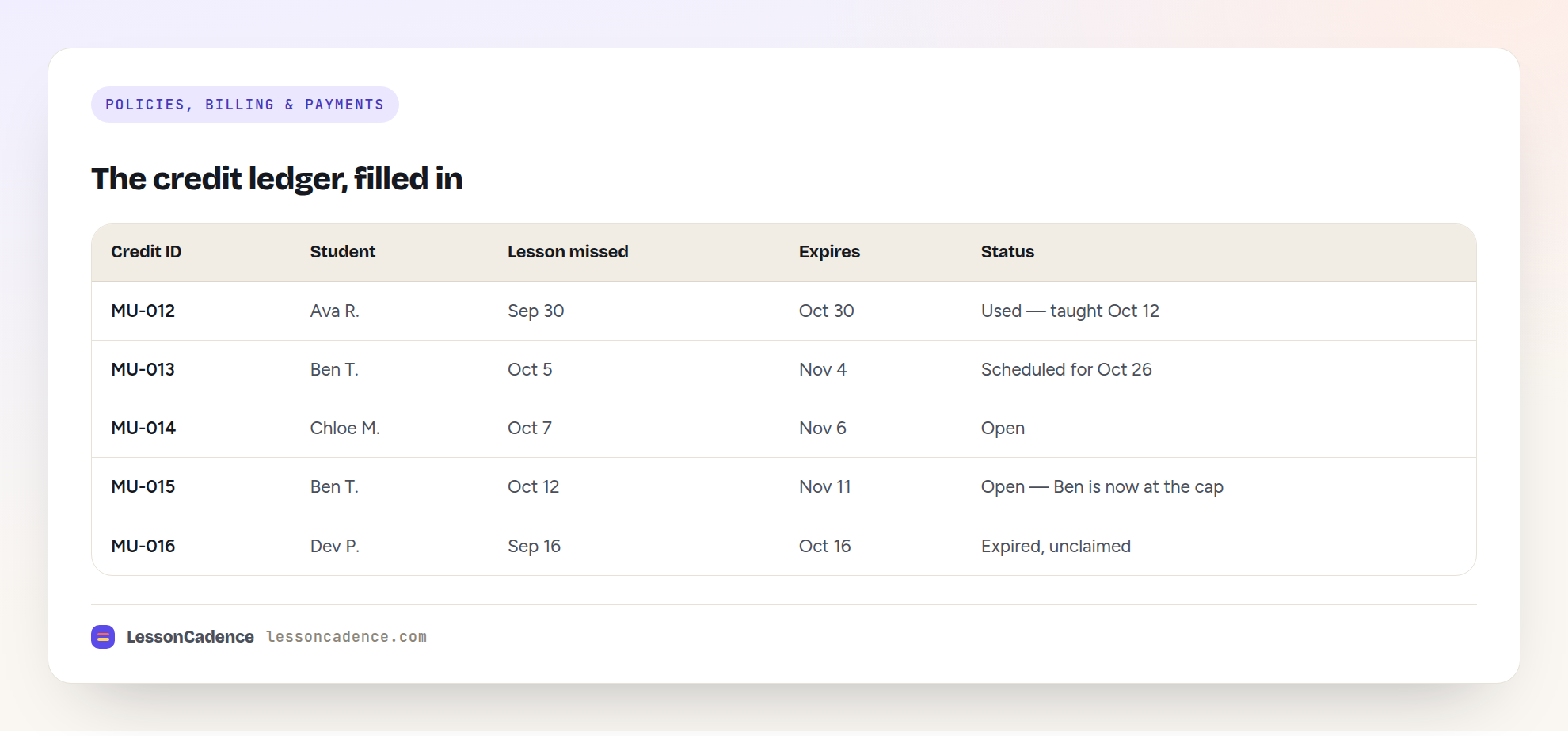
Filled in, on a two-credit cap, it looks like this:
| Credit ID | Student | Lesson missed | Expires | Status |
|---|---|---|---|---|
| MU-012 | Ava R. | Sep 30 | Oct 30 | Used — taught Oct 12 |
| MU-013 | Ben T. | Oct 5 | Nov 4 | Scheduled for Oct 26 |
| MU-014 | Chloe M. | Oct 7 | Nov 6 | Open |
| MU-015 | Ben T. | Oct 12 | Nov 11 | Open — Ben is now at the cap |
| MU-016 | Dev P. | Sep 16 | Oct 16 | Expired, unclaimed |
Two open credits at 45 minutes each is 1.5 hours you owe. Ben is at the cap, so his next cancellation is a conversation you have already had in writing — not a decision you have to make on a Tuesday night.
This is the ledger LessonCadence keeps automatically, with the policy engine checking the notice window at the moment a family reschedules and banking or declining the credit without you in the loop. The spreadsheet works fine at 20 students, and it is the right place to start.
How make-up credits interact with monthly invoicing
This is where the money actually goes, and it is almost never discussed.
The failure is simple. A student misses October 14. You take the lesson off the October invoice, dropping it from $240 to $180. Then you teach the make-up on November 20 and don't bill for it, because in your head it was already handled.
You just gave away $60. Do that for 56 absences in a term and it's $3,360 — a bigger number than anything in the hours calculation above.
The rule: a credit is a scheduling right or a money right, never both. If you reduce the invoice, no make-up is owed. If you bank a make-up, the invoice does not change.
In practice that means billing the full monthly tuition, then showing the make-up as a $0 line item that names the lesson it replaces:
| Date | Description | Amount |
|---|---|---|
| Nov 4, 11, 18, 25 | Weekly lesson, 45 min | $240.00 |
| Nov 20 | Make-up for Oct 14 (paid on Oct invoice) | $0.00 |
| Total due | $240.00 |
That $0 line does two jobs. It shows the parent the credit was honored, and it stops the "but we paid for that already" conversation before it starts. If you bill from actual attendance rather than a flat rule, the same principle holds: the make-up carries the invoice period that paid for it, not the one it was taught in.
One more distinction worth keeping precise. A make-up credit is not a prepaid lesson package. A package is money paid in advance for lessons not yet scheduled; a make-up credit is time owed for money already earned. Prepaid packages for tutoring are on the LessonCadence roadmap, not in the product today.
When credits pile up: expiry, withdrawal, and the accounting question
An unused credit is an obligation. If a family withdraws holding two open credits, you either teach two lessons after they've stopped paying or you say no to a family on the way out.
Write the answer down before it happens. Opus 1 Music Studio is the one studio above that addresses it head-on: credits expire 30 days after a membership ends. A rule like that is defensible precisely because it was disclosed at enrollment.
Credits you hold also have a bookkeeping dimension. IRS Publication 538 is clear that on the cash method you report income in the year you receive it, so tuition covering a lesson you still owe is already income this year; an accrual-basis studio can elect to defer some advance payments by a year. This is not tax advice. If you carry meaningful credit balances across a year-end, ask your accountant — our studio bookkeeping walkthrough covers what to bring them.
The family that games it
Every studio has one. They cancel at 25 hours' notice, every month, with a different reason.
You don't need a new rule for them. You need the cap, and you need to apply it the same way you apply it to everyone else. That's the entire enforcement mechanism.
When they hit the cap, send the same sentence every time: "That's your second credit this term, so the lesson on the 14th stays on the calendar. I'll see you then." No explanation, no negotiation, no exception you'll have to remember next month.
A serial 25-hour canceler is not the same problem as a family that simply doesn't show up; repeat no-shows cost you differently, and the cap is the wrong tool for them.
Inconsistent enforcement is worse than a loose policy, because it teaches families that the rule is really about who asks hardest. If you find yourself making exceptions for one family in three, your cap is set wrong — raise it for everyone and enforce the new number.
Frequently asked questions
Do music teachers have to give make-up lessons?
No. There is no professional or legal requirement to offer make-ups in a private studio. What binds you is your own published policy and your enrollment agreement. Landrum Music Studio publishes exactly that position: tuition is charged whether or not the student attends, because it covers reserving the place in the teaching schedule as well as the instruction.
How long should a make-up credit last before it expires?
Published studio policies range from 14 days to six months. Thirty days from the missed lesson is the most common and the most practical: it's long enough to find a slot, short enough that credits don't accumulate into a Saturday you can't afford. Always name an expiry date in writing.
Can I charge for a missed lesson and still give a make-up?
Yes, and that's the correct structure. The tuition paid for the reserved time; the make-up delivers that time on a different day. What you cannot do is credit the invoice and teach the make-up, because that pays for one lesson twice. Pick one and put it in the policy.
How many make-up lessons per term is normal?
One to three. Across the studios reviewed here, caps ran from one per 12-week session at Piano Plus to three open credits at a time at Opus 1 and Plumrose, with KU's community music school allowing two per semester. Two per term is a defensible middle that almost no family will argue with.
What do I do with unused credits when a student quits?
Decide before enrollment, not at withdrawal. A clean published treatment is Opus 1's: credits have no cash value and expire 30 days after the membership ends. Put a sentence like that in the enrollment agreement families sign, and the awkward conversation is a two-line email instead of a negotiation.
Sources
- Libero Piano Studio — Studio policies (one make-up per school year, illness only, "if schedules permit"; swap list for other conflicts; "No payment credit will be provided for missed lessons"): http://liberopianostudio.com/studio-policies (checked 2026-09-16)
- Piano Plus Teaching Studio — Policies ("Students are offered 1 (one) make-up lesson per 12-week session"; 24-hour notice; completed within 30 days and forfeited June 30): https://www.pianoplus.com/policies (checked 2026-09-16)
- KU Community Music School — Policy and tuition (maximum two make-ups per semester; "Instructors must be notified of absences 48 hours in advance"; no expiry or carryover stated): https://music.ku.edu/ku-community-music-school-policy-and-tuition (checked 2026-09-16)
- Opus 1 Music Studio — Private lessons studio policies (24-hour notice; "No more than three make-up lesson credits can be pending at a time per membership"; credits expire 30 days after membership ends): https://opus1musicstudio.com/studiopolicies/ (checked 2026-09-16)
- Plumrose Piano Studio — Studio policy (48-hour notice via the student portal; "a maximum of 3 makeup credits per 90-day period"; unbooked credits expire six months after the cancellation): https://plumrosepiano.com/studio-policy (checked 2026-09-16)
- Open Lid Piano Studio — Studio policy ("24-hour notification is required for the possibility of a lesson 'make-up'"; scheduled within 14 days of the original lesson; no cap published): https://www.openlidpiano.studio/piano-lesson-info/studio-policy (checked 2026-09-16)
- Landrum Music Studio — Swap list / make-up policy ("Tuition is charged even if your student is absent. Tuition covers reserving a place in my teaching schedule, as well as the instruction"; "It is the student's responsibility to make the 'swap' and email me to let me know of the switch"): https://landrum.duetpartner.com/makeup-policy (checked 2026-09-16)
- Joy Morin Piano Studio — Policies and procedures (rescheduling "cannot be guaranteed"; 24 hours' notice requested; four unpaid flex weeks held in the studio calendar for the instructor, taught free if unused): https://pianostudio.joymorin.com/policies--procedures.html (checked 2026-09-16)
- Wendy Stevens, ComposeCreate — "Flex Weeks: Taking Time off for Snow Days, Jury Duty, & Illness Without Losing Income" ("I only teach 38 weeks the entire year which gives me six of these unassigned vacation weeks," billed in 12 equal payments), published March 2013: https://composecreate.com/snow-days-jury-duty-illness-oh-my/ (checked 2026-09-16)
- Internal Revenue Service — Publication 538, Accounting Periods and Methods ("Generally, you report income in the tax year you receive it" under the cash method; an accrual-method taxpayer may elect to postpone an advance payment to the next year, but no further): https://www.irs.gov/publications/p538 (checked 2026-09-16)
Written for teachers by the LessonCadence team. Last reviewed: 2026-09-16.