The music lesson cancellation policy, in three copy-paste versions
A music lesson cancellation policy needs to settle two things: how much notice you require, and what happens to the money when a family misses that window. Most published studio policies land on 24 hours. The money is your real decision — charge in full, bank a make-up credit, or split the difference.
The short version
- 24 hours is the most common notice window in publicly posted studio policies. 48 hours shows up at studios that mostly teach working adults.
- There is no official industry standard, and there is a legal reason for that. More below.
- Three money models: charge in full, bank a make-up credit, or a hybrid that does both depending on notice.
- Inconsistent enforcement is worse than a loose policy. Families learn the policy you actually run, not the one you wrote.
- One unenforced late cancel a week, at $60 a lesson, is $2,160 over a 36-week school year.
What a cancellation policy actually decides
Teachers agonize over the wording. The wording barely matters. Two decisions do.
Decision one: the notice window. How many hours before the lesson does a family have to tell you? This is a scheduling question. It is really asking: how long do I need to fill this slot, or to get my evening back?
Decision two: what happens to the money. A canceled lesson is either charged, credited toward a future lesson, or forgiven. Everything else in a cancellation policy is detail hanging off that one choice.
Most policies that cause fights are policies where decision two was never made. The teacher wrote "24 hours' notice is required" and stopped. Required or what? The family reads that as a polite request, because that is what it is.
Write the consequence, not just the requirement.
You are charging for time, not for a lesson
This is the sentence that ends the argument with a parent, so it is worth getting straight in your own head first.
When a family enrolls, you take a slot off the market for them. That 4:30 Tuesday is now unavailable to the three people on your waitlist, unavailable for your own teaching prep, and unavailable for a second job. You sold the reservation. The lesson is what you do with it.
Every other appointment-based profession works this way, and families already accept it — dentists, physical therapists, hair salons, and most of the activities their children already attend. Teachers are the outlier in feeling apologetic about it, largely because private teaching still gets treated as a hobby that happens to charge money.
Say it in those terms and the conversation gets short: "Your tuition reserves the time. I hold it whether or not the lesson happens, so I bill for it."
That framing also tells you how to write the rest of the policy. If you are selling reserved time, a canceled lesson is not a refund question. It is a question of whether you choose to hand back some of the value anyway.
Why 24 hours became the norm, and why nobody publishes a standard
We read nine cancellation policies published on public studio and school websites, first on August 26, 2026 and again on September 10, 2026. Here is the actual range.
| Studio (public policy page) | Notice window | What happens to the money |
|---|---|---|
| Snider School of Music | 24 hours | Make-up lesson with notice; no-show forfeits the lesson, no refunds |
| Taylor-Scott Piano Studio | 24 hours | Make-up credit, capped at two per semester, expires at term end |
| Julia Piano Studio | 24 hours (3 hours for illness) | Late cancel charged in full, no make-up |
| Piano Lessons NYC | 24 hours | Fee forfeited; doctor's certificate required for illness |
| Piano Studies LA | 24 hours | Make-up with notice; no-show charged 50% of tuition |
| Williamsburg School of Music | 24 hours | Charged for the missed lesson, "no exceptions" |
| Sing Vocal Studios | 48 hours | Charged full rate "regardless of circumstances" |
| NYC Guitar School | 48 hours | Charged for the missed lesson |
| Music & Arts (national chain) | 24 hours | Missed lesson charged; tuition non-refundable; unused lessons expire 90 days after purchase |
Two things stand out. The window clusters hard at 24 hours, with 48 appearing where the students are adults with work calendars. The money treatment is all over the map. Full charge, half charge, credit, forfeit, capped credit, all among studios using the identical 24-hour window.
So why is there no published benchmark you can point a parent to? Because teacher associations are not allowed to create one.
The Federal Trade Commission filed a complaint against the Music Teachers National Association (MTNA) in December 2013 over code-of-ethics rules that restrained competition among members; a consent order followed in April 2014. MTNA's antitrust compliance policy now instructs members directly: do not discuss "prices, fees or rates, or features that can impact... prices such as discounts, costs, salaries, terms and conditions of sale, missed lessons policies, or profit margins."
Missed-lesson policies are named explicitly. That is why your state association hands out no model language, and why any article claiming "the industry standard is X%" has nothing behind it. Your policy is yours to set. Nobody is coming to ratify it.
The three money models
| Model | How it works | Best for |
|---|---|---|
| Charge in full | Late cancel is billed as taught. No make-up. | Full schedules, waitlists, adult students, teachers who travel to students |
| Make-up credit | Late cancel becomes a credit usable in a make-up slot, usually capped and term-limited | Young children, teachers with open weekday slots, studios building goodwill |
| Hybrid | On-time notice earns a credit; late notice is charged | Most solo studios. It rewards the behavior you want instead of only punishing the behavior you don't |
The hybrid is the default we would recommend to most teachers, because it gives the notice window a job. Under a pure charge-in-full policy, a family that gives you 30 hours' notice and a family that gives you 30 minutes both lose the lesson. So why would anyone bother texting early?
Credits need three limits or they become an unpaid second schedule: a cap (two per term is common), an expiry (end of term), and no cash value. Track them in a two-column list per student: date banked, date used. LessonCadence keeps that ledger automatically, but a spreadsheet handles 20 students fine.
For the full four-model breakdown, including swap lists and flex weeks, see our make-up lesson policy guide.
Choosing your notice window
Ask one question: how long would it realistically take you to fill or repurpose that slot?
- 24 hours is right for most home studios. Your Tuesday 4:30 is not getting filled on a Monday night regardless, but 24 hours lets you cancel a trip out, move a sibling up, or finish your own practicing.
- 48 hours suits studios teaching working adults, and teachers who commute to students' homes. Two business days is also the only window that survives a Monday lesson — a 24-hour rule on a Monday 4pm lesson means a Sunday afternoon text, which nobody sends.
- Same-day for illness only is not a separate window. It is a carve-out bolted onto whichever window you chose. Handle it in the exceptions clause, not the main rule.
Do not go above 48 hours in a children's studio. A week's notice is unenforceable against a fever, and an unenforceable rule teaches families that your rules are decorative.
Pick the window you will actually hold, then hold it.
The music lesson cancellation policy text, three versions
Copy one. Replace the bracketed values. Put it in your studio handbook and on the enrollment form families sign.
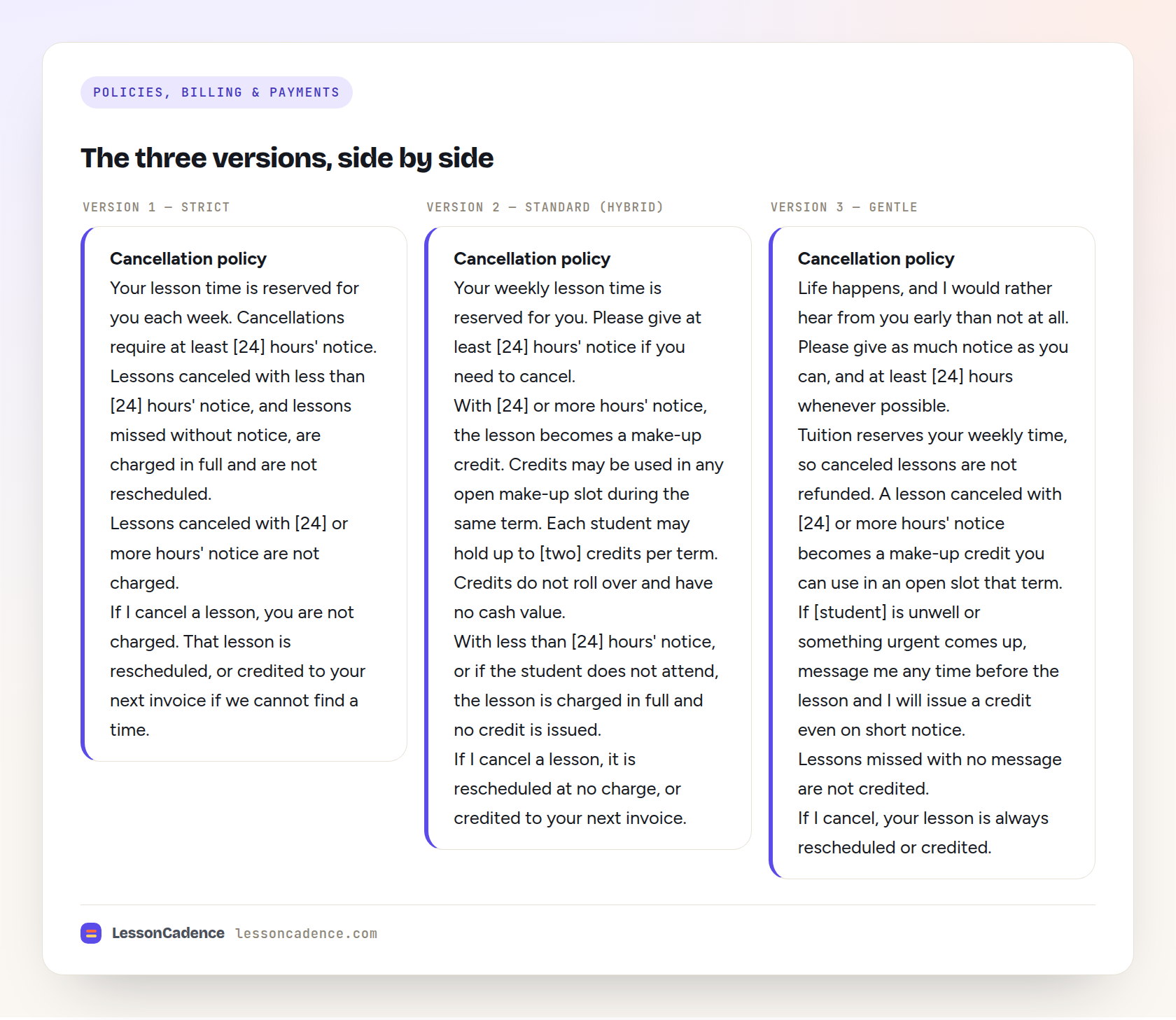
Version 1 — Strict
Cancellation policy
Your lesson time is reserved for you each week. Cancellations require at least [24] hours' notice.
Lessons canceled with less than [24] hours' notice, and lessons missed without notice, are charged in full and are not rescheduled.
Lessons canceled with [24] or more hours' notice are not charged.
If I cancel a lesson, you are not charged. That lesson is rescheduled, or credited to your next invoice if we cannot find a time.
Version 2 — Standard (hybrid)
Cancellation policy
Your weekly lesson time is reserved for you. Please give at least [24] hours' notice if you need to cancel.
With [24] or more hours' notice, the lesson becomes a make-up credit. Credits may be used in any open make-up slot during the same term. Each student may hold up to [two] credits per term. Credits do not roll over and have no cash value.
With less than [24] hours' notice, or if the student does not attend, the lesson is charged in full and no credit is issued.
If I cancel a lesson, it is rescheduled at no charge, or credited to your next invoice.
Version 3 — Gentle
Cancellation policy
Life happens, and I would rather hear from you early than not at all. Please give as much notice as you can, and at least [24] hours whenever possible.
Tuition reserves your weekly time, so canceled lessons are not refunded. A lesson canceled with [24] or more hours' notice becomes a make-up credit you can use in an open slot that term.
If [student] is unwell or something urgent comes up, message me any time before the lesson and I will issue a credit even on short notice.
Lessons missed with no message are not credited.
If I cancel, your lesson is always rescheduled or credited.
How to introduce a new policy without a revolt
Three rules. Give a start date at least two weeks out. Say what problem it solves for them, not only for you. Grandfather anything already on the calendar.
Subject: A small scheduling change, starting [January 5]
Hi [Name],
I'm writing about one change to how I handle canceled lessons, starting [January 5].
Right now I try to reschedule almost every missed lesson. That has quietly turned into a second job, and it means I often can't offer a make-up time that actually works for you. So I'm moving to one simple rule instead.
From [January 5]:
- Cancel with [24] hours' notice or more, and the lesson becomes a make-up credit you can use in an open slot that term.
- Cancel with less than [24] hours' notice, and the lesson is charged as taught.
- If [student] is sick, message me any time before the lesson and I'll issue the credit anyway.
- If I cancel, you're never charged.
Nothing else changes — same time, same rate. Anything already on the calendar before [January 5] is handled the old way.
The full studio policy is attached. If this creates a real problem for your family's schedule, tell me and we'll sort it out.
Thanks for making this an easy studio to run.
[Your name]
Expect one or two replies asking for an exception. Grant the first one, in writing, as a one-time courtesy, and say the words "one-time courtesy."
Enforcing it consistently
Here is the uncomfortable part. A policy enforced 60% of the time is worse than no policy, because it converts a clear rule into a negotiation, and the families most willing to negotiate are the ones canceling most.
Five things make enforcement survivable:
Put the consequence in the reminder, not in the aftermath. Two randomized trials in UK hospitals, published in PLOS ONE in 2015, found that adding the specific cost of a missed appointment to a text reminder cut no-shows from 11.1% to 8.4% — a roughly 24% relative drop. That is healthcare, not music teaching, so treat it as a signal rather than a benchmark. The mechanism is the point: people respond to a stated cost before the decision, not to an invoice afterward.
Decide before the text arrives. The 7pm text canceling a 7:30 lesson is the worst possible moment to make a pricing decision. If the rule is already written, you are reporting it, not choosing it.
Let the invoice do the talking. "Per the studio policy, Tuesday's lesson is billed as taught" on a line item is a fact. The same sentence sent as a text at 7:02pm is a confrontation.
Remove yourself from the loop where you can. The reason enforcement drifts is that every instance is a manual judgment call at a bad hour. LessonCadence checks the studio's policy at the moment a family reschedules and either charges the lesson or banks the credit. But the principle holds whether software does it or you do.
Handle the family that tests it, early. There is usually one. They cancel late, apologize warmly, and ask whether you can make an exception just this once, then do it again six weeks later.
The move is not confrontation. It is a short, unemotional note after the second instance: "I've credited this one, but I want to flag that it's the second short-notice cancellation this term, so the next one will be billed as taught. If Tuesdays have become hard, let's look at moving the slot."
You have restated the rule, offered a real solution, and made the next charge unsurprising. Most families take the schedule change.
More on the awkward-conversation side of this in our guide to charging a late cancellation fee, and on preventing the cancel in the first place in how to reduce no-shows.
Illness, weather and emergency carve-outs
Write your exceptions down. An undocumented exception is not mercy, it is precedent.
Illness. Every policy needs this or it will be broken within a month. Two workable approaches: a shortened window (one studio in our sample accepts three hours' notice for illness), or credit-anyway-with-a-message. Requiring a doctor's note works for adult studios and reads as hostile in a children's studio.
Weather. Name the trigger and the default. "If [school district] closes for weather, that day's lessons are credited" removes the argument entirely. If you teach online, say whether a weather day converts to an online lesson instead.
Emergencies. Cap your discretion in advance: "one discretionary credit per student per year, at the teacher's judgment." Now generosity is a feature of the policy, not a crack in it.
Your own cancellations. State clearly that a lesson you cancel is always credited or rescheduled. This single line is what makes the whole policy read as fair rather than one-sided, and it costs you nothing you weren't already going to do.
Fold all of this into a single signed document. See the nine policies every private studio needs.
Where the policy has to live
A policy on your website is a suggestion. A policy someone signed is an agreement.
Put the cancellation clause in the enrollment document families sign before the first lesson, not only in a handbook PDF you email later. One page, signature line, date. Keep the signed copy.
Then restate it at three moments, because nobody remembers a document they signed in August:
- At the start of each term, in the same email as the calendar and any rate change. Re-signing annually is normal and gives you a clean way to update the terms.
- In the lesson reminder, in one clause: "Reply by [time] tomorrow to cancel without charge."
- On the invoice, whenever the policy actually applied to a line item.
If you change the policy mid-year, the change needs its own announcement and its own start date. Quietly tightening a rule and then enforcing it is the fastest way to lose a family who would have accepted the same rule with two weeks' warning.
The money math
Assume a $60 lesson and a 36-week school year.
| Scenario | Late cancels per year | Revenue lost |
|---|---|---|
| No policy: one unenforced late cancel a week | 36 | $2,160 |
| No policy: 25 students, two unenforced late cancels each | 50 | $3,000 |
| Same 50 late cancels, charged in full | 50 | $0 |
| Same 50 late cancels, charged at 50% | 50 | $1,500 |
Work your own version before you set the rule. Take your lesson rate, multiply by the number of late cancels you swallowed last term, and multiply by three terms. For most teachers that figure lands somewhere between a month of groceries and a mortgage payment, and it is the number that makes the awkward email worth sending.
Note what the table does not say: that you will collect every dollar. Some families will leave rather than pay for a lesson they missed. A studio with a waitlist can absorb that. A studio with three open slots should choose the credit model and keep the family.
FAQ
What is a normal cancellation policy for music lessons?
Across nine published studio policies we read, the common shape is 24 hours' notice, with the lesson either credited toward a make-up or charged in full if that notice isn't given. Studios teaching adults more often use 48 hours. There is no official standard, because associations are legally restricted from setting one.
Can a music teacher charge for a canceled lesson?
Yes, when the family agreed to the policy in advance. A cancellation fee is a contract term, not a penalty you impose afterward, which is why the policy belongs on a signed enrollment form rather than only on your website. This isn't legal advice; check local consumer rules if you're unsure.
Do music teachers have to give make-up lessons?
No. Make-ups are a choice, not an obligation, and several of the studios we surveyed offer none at all. Most teachers who do offer them cap the number per term, expire unused credits at term end, and give them no cash value, which keeps make-ups from becoming a second unpaid schedule.
Is a 24-hour or 48-hour cancellation policy better?
Choose by how long you'd realistically need to fill or repurpose the slot. 24 hours fits home studios teaching children. 48 hours fits adult students and teachers who travel, and it's the only window that survives a Monday lesson — a 24-hour rule there requires a Sunday text nobody sends.
Sources
- Snider School of Music — Lesson Policies: https://www.sniderschoolofmusic.com/policies/ (checked 2026-09-10)
- Taylor-Scott Piano Studio — Studio Policy 2025–2026: https://www.taylorscottpiano.com/policy/ (checked 2026-09-10)
- Julia Piano Studio — Policies: https://www.juliapiano.com/policies (checked 2026-09-10)
- Piano Lessons NYC — Policy: https://www.pianolessonsnyc.net/policy/ (checked 2026-09-10)
- Piano Studies LA — Lesson Rates & Studio Policy: http://pianostudiesla.com/about/lesson-rates-studio-policy/ (checked 2026-09-10)
- Williamsburg School of Music — Policy: https://williamsburgschoolofmusic.net/policy (checked 2026-09-10)
- Sing Vocal Studios — Studio Policies: https://singvocalstudios.com/studio-policies/ (checked 2026-09-10)
- New York City Guitar School — Why Music Teachers Must Have A Cancellation Policy: https://nycguitarschool.com/why-music-teachers-must-have-a-cancellation-policy-and-why-a-clear-cancellation-policy-is-essential-for-long-term-student-and-teacher-success/ (checked 2026-09-10)
- Music & Arts — Lessons Terms and Conditions: https://www.musicarts.com/cms/lessons-terms-and-conditions (checked 2026-09-10)
- Federal Trade Commission — Music Teachers National Association, Inc., In the Matter of (complaint 2013-12-16; final order 2014-04-04): https://www.ftc.gov/legal-library/browse/cases-proceedings/131-0118-music-teachers-national-association-inc-matter (checked 2026-09-10)
- MTNA — Antitrust Compliance Policy: https://www.mtna.org/Symposium/Explore_MTNA_Antitrust.html (checked 2026-09-10)
- MTNA — Studio Operations resources (reviewed; MTNA publishes no model cancellation-policy language): https://www.mtna.org/Studio_Operations.html (checked 2026-09-10)
- Hallsworth M. et al., "Stating Appointment Costs in SMS Reminders Reduces Missed Hospital Appointments: Findings from Two Randomised Controlled Trials," PLOS ONE, 2015-09-14 (n=10,111 and n=9,848; DNA 11.1% → 8.4%, OR 0.74, 95% CI 0.61–0.89): https://journals.plos.org/plosone/article?id=10.1371%2Fjournal.pone.0137306 (checked 2026-09-10)
Written for teachers by the LessonCadence team. Last reviewed: 2026-09-10.