How to reduce no-shows in a private studio
To reduce no-shows, stop treating them as a discipline problem and build a stack: a two-step reminder, a written policy with an automatic consequence, payment collected in advance, and self-serve rescheduling inside the notice window. Each layer removes a different cause. Together they turn most no-shows into moved lessons.
The short version
| Layer | What you do | What it fixes |
|---|---|---|
| 1. Reminders | Two reminders per lesson: one 24 hours out, one about two hours out | Forgetting |
| 2. Policy | A published notice window with a consequence that happens automatically | Low commitment |
| 3. Prepayment | Bill the month before it starts, on auto-pay | The "I'll just skip it" math |
| 4. Easy rescheduling | Let families move a lesson themselves, inside the window | Friction |
| 5. Measurement | Track your no-show rate as one number every month | Knowing if any of it worked |
A note on the evidence before you read on. There is no published research on no-show rates in private music studios or tutoring practices. The best available data comes from healthcare and other appointment-based services, and every number in this article is labeled as such. The mechanisms transfer well. The exact percentages do not, so measure your own.
How to reduce no-shows: start with the three causes
Work the layers in order. Reminders are cheap, fast, and uncontroversial, so they come first. Policy is next because it costs you nothing but a conversation. Prepayment changes behavior most but takes the most nerve, and easy rescheduling is the finishing layer that catches what the other three miss.
Forgetting. A weekly 4:30 lesson lives in a parent's head, not in a system. One busy Tuesday and it's gone. This is the largest group and the easiest to fix.
Low commitment. The lesson is on the calendar but it ranks below a birthday party, a make-up soccer practice, or a nap. Nothing bad happens if it's skipped, so it gets skipped.
Friction. The family knew days ago that Thursday wouldn't work. Telling you meant composing an apologetic text, so they put it off, and then it was too late to say anything at all. That one shows up as a no-show but started as a cancellation nobody sent.
Each layer below targets one of these. That's why the stack works better than any single fix.
Layer 1: reminders, at two specific times
Send two reminders per lesson: one about 24 hours before, one about two hours before.
That pairing is not arbitrary. In a randomized trial across 25 primary care clinics covering 54,066 patients, patients who got both a three-day and a one-day reminder missed 4.4% of appointments, against 5.3% for a one-day reminder alone and 5.8% for a three-day reminder alone (Steiner et al., The American Journal of Managed Care, 2018). Two beat one. That is a healthcare finding, not a music one, but the mechanism — one reminder to plan around, one to act on — is the same in a studio.
Reminders versus nothing is the better-established result. A Cochrane review of text-message reminders found attendance of 78.6% with text reminders against 67.8% with none, across seven trials and 5,841 participants (Gurol-Urganci et al., Cochrane Database of Systematic Reviews, 2013). The same review found texts performed about as well as phone calls, and in the two trials that measured cost, a text cost 55% and 65% less per attendance than a call.
What the reminder should say
Wording matters more than most teachers expect. In two randomized trials at a London hospital trust covering roughly 20,000 patients, a text reminder that stated the specific cost of a missed appointment cut non-attendance from 11.1% to 8.4%, a relative drop of about 24%. Vague cost language performed significantly worse than the specific figure (Hallsworth et al., PLOS ONE, 2015).
So name the money and the window. Copy these:
24-hour reminder (SMS):
Hi [Parent] — [Student]'s lesson is tomorrow, [Day] at [Time]. Reminder: lessons canceled with less than 24 hours' notice are billed at the full $[60] rate. Need to move it? Reschedule here: [link]
Two-hour reminder (SMS):
[Student]'s lesson is today at [Time]. See you soon. — [Studio name]
On channel: the trials above compare text messages to phone calls and letters, not to email. Nobody has run the email-versus-text study you'd want. The practical read is that text is at least as good as a call for far less effort, and email is the weaker choice for the two-hour nudge because it lands in an inbox nobody is watching at 2:15 on a Thursday. Use email for the 24-hour note if you prefer, but send the same-day one as a text.
Both reminders should send themselves. A reminder you have to remember to send is not a system. (LessonCadence sends the SMS and email reminders on a schedule you set once, which is also how My Music Staff and MakeMusic Studio handle it — automated reminders are table stakes in this category, not a reason to switch anything.)
Layer 2: a policy whose consequence is automatic
A cancellation policy that depends on you enforcing it in the moment isn't a policy. It's a hope. The whole value is that the family knows in advance exactly what happens, and knows it happens without you having to decide.
If you don't have one yet, start with the 24-hour cancellation policy template and adapt the window to your teaching week.
Three rules make the difference between a policy that works and one that gets ignored:
- State the window in hours, not vibes. "24 hours" is enforceable. "Reasonable notice" is not.
- Name the consequence, and make it the same every time. Late cancel is billed, or late cancel banks one make-up credit per term. Either is defensible. Inconsistency is not.
- Let the system apply it. The moment a family reschedules, the notice window should be checked and the outcome applied — before you ever see it.
That third rule is why LessonCadence's policy engine checks the window at the moment a family reschedules and either charges the lesson or banks a make-up credit, without you touching it. It's worth saying plainly that this is not unique: My Music Staff has shipped a studio cancellation policy with deadlines set in hours and automatic billing past the window since 2014, and MakeMusic Studio (formerly Fons) markets cancellation windows "set once, enforced automatically." If you're already on one of those, turn the feature on tonight rather than shopping for a new tool.
The trap: when a fee becomes a price
A fee can backfire. In the best-known study of this, researchers watched 10 Israeli day-care centers for 20 weeks and introduced a late-pickup fine in six of them, keeping four as controls. In the fined centers late pickups increased, and they did not fall back when the fine was removed (Gneezy and Rustichini, The Journal of Legal Studies, 2000). The fine converted a social obligation into a purchase: pay the money, buy the lateness.
The fix is framing. Your fee is not the price of skipping. It's what you charge when a slot is held and can't be re-filled. Say it that way in your policy and in your reminders — "the time was reserved for [Student] and couldn't be offered to anyone else" — and keep the fee close to the lesson rate rather than a token amount. A $10 fee on a $60 lesson prices the skip cheaply.
Layer 3: collect the money before the month starts
Prepayment removes the incentive the fee is trying to counteract. If the month is already paid, skipping a lesson is a loss to the family, not a saving. There's nothing left to gain by not showing up.
The practical version for a private studio is monthly billing in advance on a stored card or bank account: the invoice for October goes out in late September, on auto-pay, generated from the scheduled lessons. Nobody is deciding each week whether this lesson is worth $60. If you're setting this up for the first time, auto-pay for lesson billing walks through the mechanics and the safety questions parents ask.
This is the layer that changes behavior most and takes the most nerve to introduce. Introduce it at a term boundary, with a month of notice, and tie it to something the family gets — a locked-in slot for the term.
Tutors have a harder version of this problem. Academic work is often booked session by session, especially around exams, so there's no month to bill in advance and no term structure to hang a slot on. Two things help: bill the week ahead rather than after the session, and put anything recurring — a standing Tuesday algebra hour — on the same monthly-in-advance footing as a music studio. Keep genuinely ad-hoc sessions on payment at booking, so the money is collected before the slot is held. A prepaid block of sessions is the other route many tutors take, and it works the same way: once the hours are bought, skipping one is a loss rather than a saving.
Layer 4: make moving a lesson easier than skipping one
Some share of your no-shows are cancellations that never got sent. The family decided on Monday and told you never.
Be honest about how much this layer buys you on its own. In the London trials above, a reminder that included the cancellation phone number produced no statistically significant drop in missed appointments. Reducing friction did not, by itself, make people show up.
What it does is convert. A family that can move Thursday to Saturday in 20 seconds, inside your notice window, gives you a rescheduled lesson instead of an empty room. The lesson gets taught, the invoice is clean, and nobody has to send the awkward text. That's a revenue-preservation mechanism rather than an attendance one, and it's worth building for that reason.
Two conditions make it work: rescheduling has to be self-serve, and it has to respect the policy automatically. A "just text me" reschedule flow is the friction you're trying to remove.
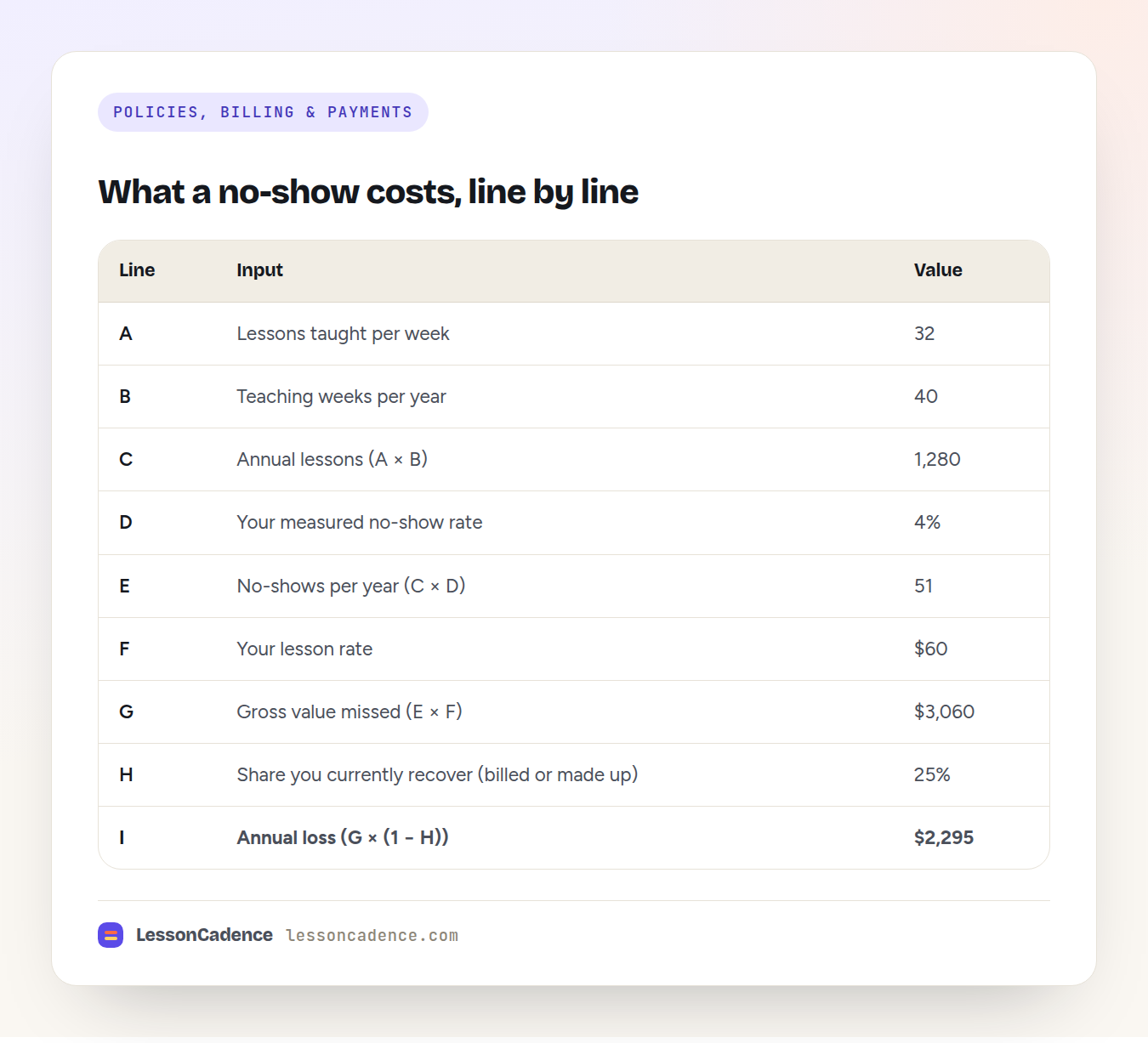
What no-shows are costing you: the formula
Run your own numbers. Don't borrow anyone's no-show rate, including a healthcare study's — measure yours from your own attendance records over the last three months.
Annual no-show loss = (lessons per week × teaching weeks per year × your no-show rate) × your lesson rate × (1 − the share you currently recover)
Worked example, illustrative:
| Line | Input | Value |
|---|---|---|
| A | Lessons taught per week | 32 |
| B | Teaching weeks per year | 40 |
| C | Annual lessons (A × B) | 1,280 |
| D | Your measured no-show rate | 4% |
| E | No-shows per year (C × D) | 51 |
| F | Your lesson rate | $60 |
| G | Gross value missed (E × F) | $3,060 |
| H | Share you currently recover (billed or made up) | 25% |
| I | Annual loss (G × (1 − H)) | $2,295 |
Now model the stack. Say the reminder and policy layers pull your rate from 4% to 1.5%, and automatic enforcement lifts your recovery from 25% to 80%. That's 19 no-shows a year, $1,140 gross, and a net loss of $228. The difference is $2,067 a year — on a studio billing about $76,800.
Those improvement figures are illustrative, not a promise. The only sourced piece is the reminder effect, and it comes from healthcare. Run it with your real numbers in the no-show cost calculator, and re-run it in three months.
For the longer version of this math, including the slot-refill and opportunity-cost angles, see what a no-show actually costs you.
After a no-show: the same-day message
Send it the same day, within a couple of hours. Waiting turns a small thing into an awkward thing, and the family is already braced for a confrontation that isn't coming.
The message does three jobs: check the family is okay, confirm the policy outcome is already handled, and re-anchor the next lesson.
Hi [Parent] — we missed [Student] at [Time] today. Everything all right?
Under the studio policy the lesson is billed / I've banked a make-up credit, and that's already applied to your account, so there's nothing for you to sort out.
[Student]'s next lesson is [Day] at [Time]. I've kept [piece / topic] on the plan for then. If [Day] has stopped working for your week, say so and we'll look at moving the slot for the rest of the term.
That last line matters. A repeat no-show at the same time slot is usually a scheduling problem wearing a commitment costume. Offer the move before the family quietly drops out.
If the no-show becomes a pattern, or the bill goes unpaid, the polite-but-firm late cancellation scripts cover the harder follow-ups.
Track it as one number a month
On the first of the month, count three things from last month: lessons scheduled, lessons taught, lessons missed with no notice. Divide missed by scheduled. That's your no-show rate.
Write it down somewhere you'll see it next month. A rate that moves from 4% to 2.5% after you turn on the second reminder is the only proof that any of this worked, and it takes about four minutes to calculate.
Watch the concentration too, not just the average. Studios often find that two or three families account for most no-shows, which is a conversation, not a systems change.
Frequently asked questions
What is a normal no-show rate for music lessons?
There is no published benchmark for private studios. Healthcare research is the closest proxy, and rates there vary enormously by setting — the control arms in one Cochrane review averaged 32% non-attendance, which is nothing like a private studio. Measure your own rate over three months and use that as your baseline.
Should I charge a no-show fee?
Charge the full lesson rate rather than a token fee, and frame it as payment for a reserved slot rather than a penalty. Research on fines shows a small penalty can read as a price people are happy to pay. Apply it consistently and automatically, or don't publish it at all.
Do text reminders really reduce no-shows?
Yes, compared with no reminder. A Cochrane review of seven trials found attendance of 78.6% with text reminders against 67.8% without, and texts performed about as well as phone calls at a fraction of the cost per attendance. That evidence is from healthcare appointments, not lessons.
How far in advance should I send lesson reminders?
Send two: one about 24 hours ahead and one about two hours ahead. A randomized trial of 54,066 patients found that two reminders (three days plus one day) beat either single reminder, cutting missed appointments to 4.4% from 5.3%. Adjust the timing to when your parents actually plan their week.
Does a make-up credit work better than a charge?
Both work if they are automatic and consistent. A charge protects revenue directly. A banked credit preserves goodwill and keeps the family engaged, but only if you cap credits per term and set an expiry — otherwise you've created an obligation to teach free lessons later.
Sources
- Gurol-Urganci I, de Jongh T, Vodopivec-Jamsek V, Atun R, Car J. "Mobile phone messaging reminders for attendance at healthcare appointments." Cochrane Database of Systematic Reviews, December 5, 2013. Attendance 67.8% with no reminders, 78.6% with text reminders and 80.3% with phone calls; the text-versus-none comparison covers 7 trials and 5,841 participants; two trials found a text cost 55% and 65% less per attendance than a call. https://www.cochranelibrary.com/cdsr/doi/10.1002/14651858.CD007458.pub3/abstract — the Cochrane site blocks automated access, so the abstract was verified 2026-09-30 via Europe PMC
- Steiner JF, Shainline MR, Dahlgren JZ, et al. "Optimizing Number and Timing of Appointment Reminders: A Randomized Trial." The American Journal of Managed Care, August 2018. 54,066 patients, 25 clinics; missed appointments 4.4% (dual reminder) vs 5.3% (1-day) vs 5.8% (3-day). https://www.ajmc.com/view/optimizing-number-and-timing-of-appointment-reminders-a-randomized-trial — checked 2026-09-30
- Hallsworth M, Berry D, Sanders M, et al. "Stating Appointment Costs in SMS Reminders Reduces Missed Hospital Appointments: Findings from Two Randomised Controlled Trials." PLOS ONE, 2015. Trial one (10,111 participants): non-attendance 8.4% with a specific-cost message vs 11.1% control, OR 0.74 (95% CI 0.61–0.89). The "Easy Call" arm, which added a cancellation phone number, showed no significant effect. https://journals.plos.org/plosone/article?id=10.1371%2Fjournal.pone.0137306 — checked 2026-09-30
- Gneezy U, Rustichini A. "A Fine is a Price." The Journal of Legal Studies, vol. 29, no. 1, January 2000, pp. 1–17. 10 day-care centers observed over 20 weeks; a fine was introduced in six, randomly selected, with four as controls; late pickups increased and did not fall when the fine was removed. https://www.journals.uchicago.edu/doi/10.1086/468061 — the publisher blocks automated access, so the full text was verified 2026-09-30 at the University of Salento's copy: https://www.unisalento.it/documents/20152/2866025/GNEEZY2000.pdf
- Al-Turbag M, Mooney M, Corry M. "A systematic review and meta-analysis of appointment reminders for enhancing hospital attendance." Journal of Hospital Management and Health Policy, March 2026. Reminders overall RR 1.11 (95% CI 1.05–1.19) across 10 studies, 8,236 participants; SMS-alone RR 1.14 (95% CI 0.99–1.31) did not reach significance. https://jhmhp.amegroups.org/article/view/10215/html — checked 2026-09-30
- My Music Staff — "New Studio Cancellation Policy Feature" (posted March 11, 2014): notice deadlines set in hours, default 24 hours, attendance set to "Absent, No Make-Up" and the student billed past the deadline, with teacher override. https://www.mymusicstaff.com/new-studio-cancellation-policy-feature/ — verified 2026-09-30
- My Music Staff — Pricing: "SMS reminders are included in your subscription." https://www.mymusicstaff.com/pricing/ — verified 2026-09-30
- MakeMusic Studio (formerly Fons) — Pricing: "Cancellation windows set once, enforced automatically"; automated text and email reminders. https://www.studio.makemusic.com/pricing — verified 2026-09-30
All research findings above come from healthcare and appointment-based service settings. No published research measures no-show rates in private music studios or independent tutoring practices. Treat the mechanisms as transferable and the percentages as not.
Written for teachers by the LessonCadence team. Last reviewed: 2026-09-30.