Why students quit music lessons — and the four fixes that work
Students quit music lessons for four reasons: they can't see themselves getting better, the parent paying the bill never sees what happens in the lesson, the schedule became a hassle, or the price stopped feeling worth it. Three of those four are fixable with systems, not charisma.
If you just lost three students in a month, the useful question isn't why students quit music lessons in general. It's which of the four is happening in your studio, and whether you could have seen it coming six weeks earlier. Usually you could have.
The short version
- Four causes. Invisible progress, a disengaged parent, scheduling friction, and price-versus-perceived-value. Talent and teacher charisma are rarely the issue.
- Quitting is a slow decision. In the largest study available, students who dropped out had studied slightly longer than those who stayed and reached a significantly lower playing level — long before anyone said the word "quit."
- The warning signs are administrative. Attendance slippage, unpracticed assignments, slower parent replies, and late payments show up before the resignation email does.
- Cost is rarely the stated reason. In the largest study of piano dropouts available, only four of 55 parents named cost.
- The data is genuinely thin. There is no US national attrition rate for private lessons. Anyone quoting one is guessing. Below is what actually exists.
What the research actually says (and what it doesn't)
Start with the honest part: there is no reliable national dropout rate for private music lessons in the United States. No association publishes one, no government dataset tracks it, and the studies that exist are small, mostly piano-specific, and mostly not American. If you see "80% of students quit within two years" on a studio blog, it has no source behind it.
Here is what does exist, and it's more useful than a made-up percentage.
The closest thing to a US benchmark is teacher-reported tenure. The 2024 Music Teachers National Association (MTNA) member survey, fielded October–December 2024 with 2,815 independent-studio responses, asked how many years an average student studies with you. The answers: 1% said one year or less, 40% said two to five years, 52% said six to 10 years, and 7% said more than 10 years. That's a self-reported average from association members, not a churn rate, and MTNA members skew toward the more established end of the profession. Treat it as a ceiling, not a norm.
The largest dropout study is Canadian and piano-only. Gerelus, Comeau, and Swirp (2017) compared 55 former piano students with 153 who planned to continue. The dropouts had started at about seven, studied for an average of 4.9 years, and quit at around age 12 — which the authors note confirms the commonly held belief in a pre-teen dropout stage. The earlier work they cite for a first sharp surge at age 11 is Evans (2009), not their own data.
The clearest finding is about progress, not personality. In that same study there was a significant difference between the two groups' rates of progress: the students who dropped out had reached significantly lower playing levels, averaging Level 2 of the Royal Conservatory syllabus after 4.9 years. They rated their own musical ability below the continuing group — while still placing themselves slightly above average.
A widely quoted 86.5% dropout figure exists, and it should be handled carefully. It comes from a 2024 Frontiers in Psychology study of Slovenian public music schools, and the authors themselves write that it must be interpreted tentatively because of incomplete enrollment data. Slovenian music schools have entrance exams and a compulsory solfège curriculum. It is not your studio.
And in school ensembles, decades of work haven't produced a clean answer. Hash's 2021 literature review of 35+ years of band and orchestra retention research concluded it has "yielded little consistency" in explaining why students persist or leave. That's a fair summary of the whole field.
So: small samples, no US baseline, and no single cause. What the studies do agree on is the shape of the problem, which is what the four causes below describe.
The four reasons why students quit music lessons
1. Progress stopped being visible
This is the best-evidenced cause. Dropouts aren't necessarily worse students — they're students who advanced more slowly and knew it. Costa-Giomi, Flowers, and Sasaki (2005) videotaped first-year lessons of 14 matched pairs of piano students. The ones who later quit sought approval from the teacher more often and received fewer approvals, and they met the goals set in the lesson less often.
The student's internal story becomes "I'm not good at this." Nobody quits a thing they feel good at.
2. The parent never sees the lesson
The person deciding whether to keep paying is usually not in the room. In Macmillan's 2004 interview study, half the parents said they almost never attend lessons, only a quarter felt their teacher encouraged them to attend at all, and half said the subject had simply never come up.
Be careful with the causal claim here, because the research is mixed. Gerelus and colleagues found parental involvement was not a significant predictor of dropping out — dropout parents actually helped with practice slightly more. What the parent's absence changes is not the child's ability. It's the parent's ability to judge whether the money is working. An invisible lesson gets valued at whatever the child reports on the drive home.
3. Scheduling friction
Competing commitments dominate the qualitative research. In the Slovenian focus-group study, "competing extracurricular commitments" came up 23 times across five groups. MTNA's 2024 respondents flagged "overscheduled students" causing missed lessons as a live problem.
Friction compounds. A missed lesson that's awkward to reschedule becomes two missed lessons, and two missed lessons become a family quietly deciding the term is a write-off.
4. The price stopped matching the perceived value
Notice the wording. Not "too expensive" — mismatched. Only four of 55 dropout parents in the Gerelus 2020 study named cost as a reason. Families don't leave because $60 is a lot of money. They leave because $60 stopped buying something they could describe.
The early-warning checklist
Quitting is a decision made over weeks. These are the signals that show up first, with thresholds you can actually check. Run this monthly against your calendar and your invoices.
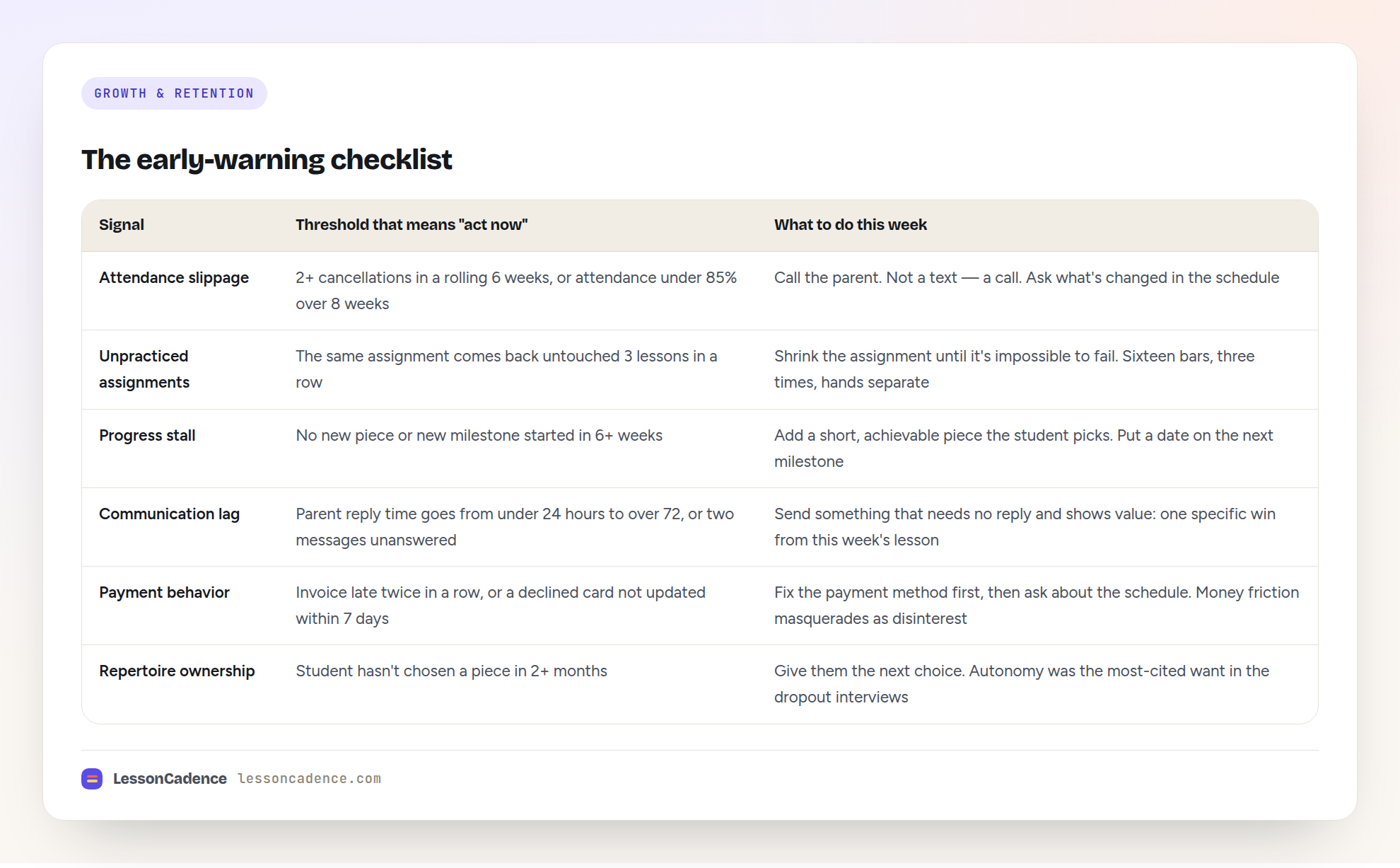
| Signal | Threshold that means "act now" | What to do this week |
|---|---|---|
| Attendance slippage | 2+ cancellations in a rolling 6 weeks, or attendance under 85% over 8 weeks | Call the parent. Not a text — a call. Ask what's changed in the schedule |
| Unpracticed assignments | The same assignment comes back untouched 3 lessons in a row | Shrink the assignment until it's impossible to fail. Sixteen bars, three times, hands separate |
| Progress stall | No new piece or new milestone started in 6+ weeks | Add a short, achievable piece the student picks. Put a date on the next milestone |
| Communication lag | Parent reply time goes from under 24 hours to over 72, or two messages unanswered | Send something that needs no reply and shows value: one specific win from this week's lesson |
| Payment behavior | Invoice late twice in a row, or a declined card not updated within 7 days | Fix the payment method first, then ask about the schedule. Money friction masquerades as disinterest |
| Repertoire ownership | Student hasn't chosen a piece in 2+ months | Give them the next choice. Autonomy was the most-cited want in the dropout interviews |
Two or more signals on the same student at the same time is the pattern that precedes a quit by roughly six to eight weeks in practice. That window is the whole point — it's long enough to change the outcome.
Running it takes about 15 minutes a month. Open your calendar and your unpaid-invoice list side by side, write down every student who trips a threshold, and act on the ones who trip two. Most months that's one or two names. Your calendar and invoices already hold every one of these signals — LessonCadence keeps the attendance record and the payment status in the same place, but it does not compute a retention number for you, so the monthly pass is manual either way.
To turn this into a number you track over time rather than a gut feeling, see our guide to calculating your studio's retention rate.
Fix #1: make progress visible
The student needs evidence, weekly, that last month's hard thing is now easy. Three things do this cheaply:
- A named milestone with a date. "Minuet in G, both hands, by October 30." Vague goals can't be achieved, so they can't feel like achievement.
- A practice log the student fills in, not you. Marks on a page are proof. Our practice log template is built for this.
- A recording every eight weeks. Thirty seconds on a phone. Play September's back in November. This converts invisible progress into something a 10-year-old can hear.
The rule: never let six weeks pass without the student finishing something.
Fix #2: make the parent an audience
The parent doesn't need to supervise practice. They need to be told a story about their child, every week, in under 60 seconds of reading.
That's what a lesson note is for — not a homework list for you to feel organized about, but four lines the parent will actually read: what we did, what went well, what to practice and how, and what to listen for at home. Our lesson note templates lay this out in full, and what to say to parents between lessons covers the cadence.
If you'd rather the parent see notes without you sending anything, LessonCadence's parent portal shows them the lesson note and the current practice assignment as soon as you save it. A shared Google Doc per family does the same job at 20 students.
Fix #3: take the friction out of scheduling
Make rescheduling easier than quitting. That's the entire goal.
- Publish the cancellation window and the make-up rule once, in writing, so nobody has to ask.
- Send reminders — 24 hours ahead, and again the morning of.
- Let families move a lesson themselves inside the policy, instead of texting you and waiting.
- Track your no-show rate as a monthly number. If you don't have one, our guide to reducing no-shows has the math.
A family that can fix a conflict in 15 seconds stays. A family that has to compose an apologetic text starts avoiding the whole relationship.
Fix #4: reframe the price around what they're getting
Run the numbers on what a quit costs you before you decide it's a pricing problem.
MTNA's 2024 survey puts the median 60-minute independent-studio rate at $60 (average $65.72); it publishes roster sizes only as a distribution, so take 20 students as an illustration rather than a benchmark. Three students lost, over a 36-week teaching year:
3 × $60 × 36 = $6,480 a year.
On a 20-student studio billing $43,200, that is 15% of your gross — and the slots sit empty while you fill them. Against that, an hour a month spent on lesson notes and progress milestones is cheap.
Now the reframe itself. Parents don't compare your rate to other piano teachers. They compare it to nothing at all, because they can't see what they bought. Give them the comparison:
"For the fall term, Maya has 14 lessons, a recital, weekly notes, and a practice plan. That's $840, or $60 a week for one-to-one time with a specialist."
Same money. Now it has edges.
The exit conversation
When a family does leave, ask one question and don't defend the answer.
"Before you go — I'd genuinely value knowing what wasn't working. It helps me teach better. And the door's open if you want to come back in the spring."
Two things happen. You get real data about your own studio, which no research paper can give you. And you leave the relationship intact — a meaningful share of returning students are families who quit politely and were invited back.
Write the reason down. Four of these over a year is your own dataset, and it beats anyone else's.
The seasonal spikes
Teachers consistently report three quit clusters: after the spring recital, over the December holidays, and at the end of the school year in June. I could not find published data confirming this pattern — it's practitioner observation, not evidence, and you should verify it against your own records before acting on it.
The logic behind it is sound, though. Each one is a natural stopping point where a family has to actively re-decide. Pre-empt them the same way: before every break, put the next milestone and the return date in writing. A student with a date to come back to is not making a decision.
FAQ
How long do most students stay in music lessons?
There's no reliable national figure. The best available US proxy is the 2024 MTNA member survey, where 40% of independent teachers said their average student stays two to five years and 52% said six to 10. That's self-reported by association members, so it likely overstates the typical studio.
At what age do kids usually quit music lessons?
In the largest piano dropout study available, students quit at an average age of 12, after about 4.9 years of lessons; earlier work it cites puts the first sharp surge at age 11. That timing lines up with the transition to middle school and a sharp rise in competing activities.
Is it my fault when a student quits?
Usually not, and the research supports that. Teacher-relationship problems were uncommon in the dropout interviews, and cost was named by only four of 55 parents. What did separate the groups was rate of progress and how capable students felt. Those are things you can influence.
Should I let a student quit or try to talk them out of it?
Ask first, argue never. If two or more early-warning signals appeared in the previous six weeks, there's usually something specific and fixable behind it — the repertoire, the schedule, or a stalled milestone. If none did, let them go gracefully and invite them back.
Does making parents attend lessons improve retention?
The evidence doesn't support requiring it. One study found parental involvement wasn't a significant predictor of dropping out at all. What matters is that the parent can see what's happening, which a weekly note delivers without anyone sitting in the room.
Sources
- Music Teachers National Association, 2024 MTNA Member Survey Summary (fielded October–December 2024; 2,815 Track 1 independent-studio responses) — years an average student studies (1% one year or less, 40% two to five, 52% six to 10, 7% more than 10); 60-minute rate median $60, average $65.72; "overscheduled students" named among challenges with students. https://www.mtna.org/_Library/_documents/MemberSurvey2024_Summary.pdf (checked 2026-09-30)
- Gerelus, K., Comeau, G., & Swirp, M. (2017). "Predictors of Piano Student Dropouts." Intersections, 37(2). 55 former students vs. 153 continuing — age at quitting, years of study, a significant difference in rate of progress, and the finding that almost none of the parental-involvement results reached significance. https://piano.uottawa.ca/wp-content/uploads/2020/10/36.-Gerelus-et-al_Dropouts-2017.pdf (checked 2026-09-30)
- Gerelus, K., Comeau, G., Swirp, M., & Huta, V. (2020). "Parting Ways With Piano Lessons: Comparing Motivation Between Continuing and Dropout Piano Students." Bulletin of the Council for Research in Music Education. Reasons given for quitting; four of 55 parents cited cost. https://static1.squarespace.com/static/5b885f5431d4df9709f6ebf5/t/601e235a5ec1fc131bcef17f/1612587867460/BCRME+Summer+2020+Gerelus.pdf (checked 2026-09-30)
- Costa-Giomi, E., Flowers, P. J., & Sasaki, W. (2005). "Piano Lessons of Beginning Students Who Persist or Drop Out." Journal of Research in Music Education, vol. 53, pp. 234–247. Two videotaped first-year lessons of 14 matched pairs; dropouts sought approval more often, received fewer approvals, met lesson goals less often and scored lower in the end-of-year exam. https://journals.sagepub.com/doi/10.1177/002242940505300305 — the publisher blocks automated access, so the abstract was verified 2026-09-30 at https://eric.ed.gov/?id=EJ739992
- Kavčič Pucihar, A., Habe, K., Rotar Pance, B., & Laure, M. (2024). "The key reasons for dropout in Slovenian music schools — a qualitative study." Frontiers in Psychology. 29 participants across five focus groups; the 86.5% dropout estimate and the authors' own caveat; competing commitments cited 23 times. https://www.frontiersin.org/journals/psychology/articles/10.3389/fpsyg.2024.1385840/full (checked 2026-09-30)
- Hash, P. M. (2021). "Student Retention in School Bands and Orchestras: A Literature Review." Update: Applications of Research in Music Education, 40(3). "At least 35 years of research, however, has yielded little consistency in determining why students persist in or dropout of instrumental study." School ensembles, not private studios. https://journals.sagepub.com/doi/abs/10.1177/87551233211042585 — the publisher blocks automated access, so the abstract was verified 2026-09-30 at https://eric.ed.gov/?id=EJ1342885
- Macmillan, J. (2004). "Learning the piano: a study of attitudes to parental involvement." British Journal of Music Education, 21(3). Interviews with 10 teachers, 20 pupils and 20 parents: 10 parents (50%) say they almost never attend lessons, five (25%) feel encouraged to attend, and 10 (50%) are neither encouraged nor discouraged — "often the subject has never been mentioned." http://www.jennymacmillan.co.uk/uploads/6/6/2/1/66215923/bjme_paper.pdf (checked 2026-09-30)
Data note: no US national attrition rate for private music lessons was found in any government, association, or peer-reviewed source as of 2026-09-30. Every quantitative figure above comes from a small or non-US sample and is labeled as such. The six-to-eight-week early-warning window and the seasonal quit clusters are practitioner patterns, not published findings. Where a study reports a result only inside a table we cannot read at the source, this article states the finding in the words the paper uses rather than quoting a number.
Written for teachers by the LessonCadence team. Last reviewed: 2026-09-30.