Lesson note templates parents actually read
A lesson note has two readers with opposite needs. The student needs the assignment. The parent needs the story. A lesson note template that serves both has four parts: what we did, what went well, what to practice and how, and what to listen for at home. Write it in the last 90 seconds of the lesson, not at 10pm.
The short version
- Four parts, always: what we did / what went well / what to practice and how / what to listen for at home.
- Write it in the room, in the last two minutes, with the student watching. Notes written at night are vaguer and cost you an unpaid hour a week.
- Specificity is the whole game. "Measures 9–16, hands separate, three times slowly" gets done. "Practice the piece" does not.
- Give the parent a job that isn't policing. One thing to listen for beats "make sure she practices."
- The no-practice lesson gets a shorter assignment, not a sterner note. Cut it to one item so a win is available.
Why most lesson notes go unread
Most notes fail for one of two reasons. They are written for the student only, so the parent gets a list of measure numbers that means nothing to them. Or they are written for the parent only, so the student gets a warm paragraph with no instructions in it.
The research on this is more useful than you'd expect, because it is mostly research about parents.
Andrea Creech's study of 337 violin parent-pupil-teacher trios found that pupil outcomes — enjoyment, motivation, self-efficacy, self-esteem — improved when parents did a specific set of things, including providing a structured home environment for practice and communicating with the teacher about progress. The worst outcomes came from what she called the "discordant trio": low perceived teacher leadership and parents who felt powerless.
Powerless, in practice, usually means uninformed. A parent who does not know what happened in the lesson cannot support what happened in the lesson.
A separate Australian case study of 34 piano students and their parents — the author's own pupils, so read it as suggestive rather than definitive — found something even more pointed. Parents' attendance at lessons correlated moderately with attainment (r = 0.550). Supervising practice without attending correlated at 0.069 — essentially nothing. Supervision only helped when the parent had access to what the teacher actually said.
Most of your parents will never sit in on a lesson. The note is the substitute. That is the entire job it does.
One more finding worth holding onto: in a survey of 2,583 families conducted through Canada's Royal Conservatory, researchers found that positive teacher-student relationships and parental involvement in practice between lessons predicted both enjoyment and musical progress. Parents were, in the authors' words, "deeply invested." They are not disengaged. They are under-briefed.
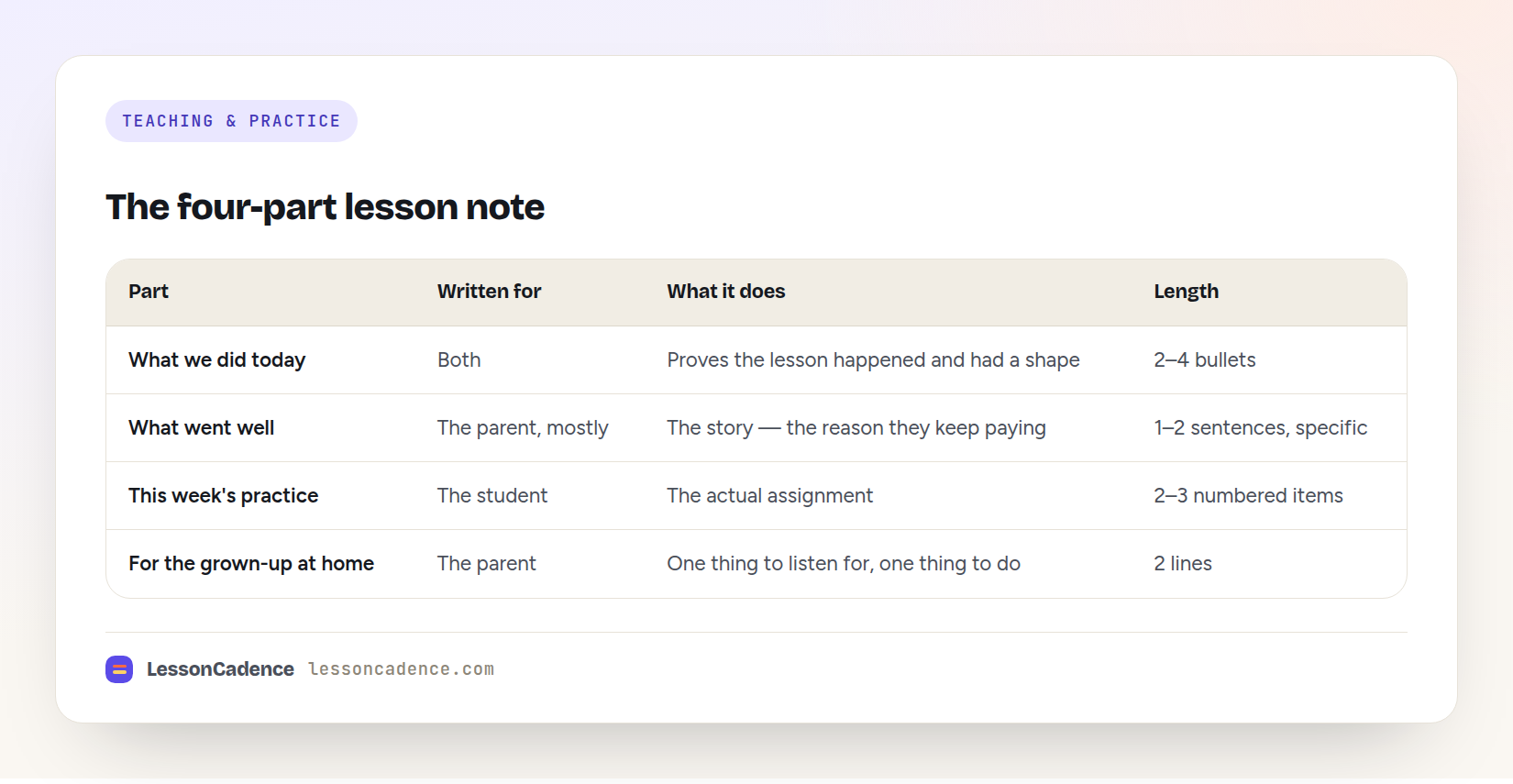
The four-part lesson note structure
| Part | Written for | What it does | Length |
|---|---|---|---|
| What we did today | Both | Proves the lesson happened and had a shape | 2–4 bullets |
| What went well | The parent, mostly | The story — the reason they keep paying | 1–2 sentences, specific |
| This week's practice | The student | The actual assignment | 2–3 numbered items |
| For the grown-up at home | The parent | One thing to listen for, one thing to do | 2 lines |
The "what went well" line is the one teachers skip and the one parents read first. It has to be specific to be believed. "Great lesson!" reads as filler. "She found the F on her own three times in a row — last week she counted up from middle C every time" reads as evidence that you were paying attention to their child.
That sentence is also, quietly, your retention strategy. Families rarely quit because of one bad month. They quit because they stopped being able to see progress, which is a different problem than it looks like.
The 90-second rule
Write the note in the last two minutes of the lesson, on the same screen or notebook, while the student packs up.
Three reasons. You remember what happened, so it is accurate. The student sees the assignment being written, so it is not a surprise on Wednesday. And it never becomes homework.
The math on that last one is worth doing. Say you teach 25 students and spend four minutes per note at night. That is 100 minutes a week — about an hour and 40 minutes of unpaid admin, or roughly 63 hours across a 38-week teaching year. At a $60 lesson rate, that time is worth $3,780. Written in the room, the same notes cost you nothing, because the last 90 seconds of a lesson is time the family already paid for.
It also stops the note from drifting into review-writing. Ninety seconds is enough for four bullets and an assignment. It is not enough to write a paragraph about attitude, which is a paragraph you should not be writing anyway.
If you keep notes in a system, the family should be able to see them without you emailing anything. LessonCadence keeps the note and the practice assignment on the lesson record with a family view, so the parent opens the portal instead of digging through email — but a shared Google Doc per student does exactly this job at 15 students, and costs nothing.
How specific does a practice assignment have to be?
Specific enough that a substitute teacher could hand it to the student and get the same week of work.
This is not a style preference. Katie Zhukov's review of the practice research quotes Rosenshine, Froehlich and Fakhouri on exactly this point: "practice at home is facilitated if the teacher gives specific instructions about what needs to be worked on, how to do it, and what the result should sound like." The same review reports Hallam's finding on what novices do when left to themselves — repeating the piece from beginning to end without stopping to work the hard sections, and leaving errors uncorrected for most of the practice session.
A vague assignment does not produce less practice. It produces practice that reinforces the mistakes.
The assignment-specificity rubric
Score each item you write. Anything below Level 3 gets rewritten.
| Level | Example | Result |
|---|---|---|
| 0 | "Practice." | Ignored |
| 1 | "Practice Minuet in G." | Played start to finish, mistakes and all |
| 2 | "Minuet in G, measures 9–16." | Right section, wrong method |
| 3 | "Minuet in G, mm. 9–16, hands separate, three times each hand, slowly." | Gets done |
| 4 | Level 3 plus: "…until each hand runs three times with no stops. Five days. It should sound even, with no pause before the trill." | Gets done, and the student knows when to stop |
Five elements, every time. Piece. Place. Method. Dose. Sound.
- Piece — which one, and the page number if the book has two of them
- Place — measures, section, or "the whole thing" if you mean the whole thing
- Method — hands separate, slow with a metronome, sing then play, count out loud
- Dose — how many times, or how many minutes, and how many days
- Sound — what success sounds like, in words a 10-year-old can check themselves against
The "sound" element is the one almost nobody writes, and it is the one that lets a student practice without an adult standing there. "Even, with no pause before the trill" is a target a child can hear. "Better" is not.
Writing for the parent without patronizing the student
Address the note to the student. Let the parent read over the shoulder. That single choice solves most of the tone problem.
Then give the parent their own two lines, clearly labeled, and make the job small and non-musical. "Listen for a steady beat — speed doesn't matter yet" is a job a parent with no musical training can do. "Make sure she practices properly" is not a job, it is a source of arguments.
Three rules for that section:
- Ask for a specific, five-minute action, not supervision in general.
- Give parents permission to not know music. Most of them are anxious about it, and the anxious ones become the pushy ones.
- Never write anything you would not say to the student's face, because you are writing it in front of them.
The rest of the parent relationship — the check-in emails, the term-end summary, the conversation before someone quits — sits outside the lesson note. The note's job is weekly and small.
Three full lesson note templates
Copy these. Replace the bracketed parts. The filled examples use invented students and are illustrative only.
Template 1 — Beginner child (ages 5–10)
LESSON NOTE — [Student] — [Date]

WHAT WE DID TODAY
- [2-4 short items, in the order we did them]

WHAT WENT WELL
[One specific thing this student did better than last week.]

THIS WEEK'S PRACTICE
1. [Piece] - [measures] - [method] - [dose] - [what it should sound like]
2. [Piece] - [measures] - [method] - [dose] - [what it should sound like]
3. [Piece] - [measures] - [method] - [dose] - [what it should sound like]
Practice [N] days this week. Each day should take about [N] minutes.

FOR THE GROWN-UP AT HOME
Listen for: [one thing a non-musician can hear]
You can help by: [one concrete five-minute action]

BRING NEXT WEEK: [books, folder, anything else]
Filled in:
LESSON NOTE — Ellie R. — Monday, September 21

WHAT WE DID TODAY
- Warm-up: C five-finger pattern, hands separate
- "Bell Song" - played it hands together for the first time
- Started "Rain Dance" - clapped the rhythm and named the notes
- Flashcards: bass clef F, A, C

WHAT WENT WELL
Ellie found the F on her own three times in a row today. Last week she
counted up from middle C every time.

THIS WEEK'S PRACTICE
1. C five-finger pattern - right hand, then left hand - three times each,
   slowly, counting to four out loud. It should sound even, like a clock.
2. "Bell Song" (p. 14) - the whole piece, hands together - three times a
   day, slowly enough that you never stop. If you stop in the same place
   twice, that spot gets five extra tries on its own.
3. "Rain Dance" (p. 16) - measures 1-8 only - clap and count the rhythm
   out loud twice, then play right hand alone twice.
Practice five days this week. Each day should take about 12 minutes.

FOR THE GROWN-UP AT HOME
Listen for: a steady beat in "Bell Song," with no pauses in the middle.
Speed does not matter yet.
You can help by: setting a timer for 12 minutes and staying in the room
for the first one. You do not need to know any music. If she stops in
the same spot twice, that is tomorrow's spot.

BRING NEXT WEEK: Lesson book, theory book, green folder.
Template 2 — Teen student
Teens want to be treated as the owner of the work. The parent section shrinks to a logistics line, and a deadline replaces the daily count.
LESSON NOTE — [Student] — [Date]

WHAT WE DID
- [2-4 items, with a number where there is one: tempo, reps, accuracy]

WHAT'S WORKING
[One specific improvement, and the reason it improved.]

THIS WEEK
1. [Piece/skill] - [place] - [method] - [dose] - Success = [measurable]
2. [Piece/skill] - [place] - [method] - [dose] - Success = [measurable]
3. [Skill work] - [dose]
[N] days minimum. About [N] minutes.

TARGET
[Recital / audition / exam date] - [what must be true by when]

FOR PARENTS
[One line: on track or not, and what is needed at home. Usually time.]
Filled in:
LESSON NOTE — Marcus T. — Wednesday, September 23

WHAT WE DID
- F barre chord at 60 bpm - 8 of 10 clean
- "Blackbird" - intro, bars 1-8, thumb independence
- Sight-read two 8-bar exercises in first position

WHAT'S WORKING
Your barre buzzes far less than it did two weeks ago. The fix was wrist
position, and you are finding it yourself now instead of waiting for me
to say it.

THIS WEEK
1. F barre - press, strum, release, move the hand away, come back.
   10 reps, twice a day. Success = 8 of 10 with no buzz on any string.
2. "Blackbird" bars 1-8 - thumb alone first (bass line only), four times
   at 60 bpm, then add the melody. Do not go faster than the tempo where
   it is clean.
3. Sight-reading - one new 8-bar exercise a day, no repeats. Play it
   once, badly, and move on. That is the point of it.
Four days minimum. About 25 minutes.

TARGET
Recital is November 14. "Blackbird" needs to be memorized through bar 24
by October 15 for it to feel comfortable on the day.

FOR PARENTS
Marcus is on track. Nothing needed this week except protected time -
25 minutes, four evenings.
Template 3 — Adult student
No parent section. Adults quit over guilt more than over difficulty, so the template plans for the bad week in advance.
LESSON NOTE — [Student] — [Date]

WHAT WE COVERED
- [2-4 items, including the diagnosis, not just the activity]

WHAT'S WORKING
[One specific improvement. Adults get less of this than children and
need it more.]

THIS WEEK
1. [Item] - [place] - [method] - [dose]
2. [Item] - [place] - [method] - [dose]
3. [The one fix that matters most]

IF YOU ONLY GET 10 MINUTES
[The single highest-value item, named.]

REALITY CHECK
[Anything you know about their week, and permission to have it.]
Filled in:
LESSON NOTE — Dana K. — Thursday, September 24

WHAT WE COVERED
- Blues scale in A, two octaves, metronome at 72
- "Autumn Leaves" - comping the A section, rootless voicings
- Diagnosed bar 5: you are reading it rather than hearing it

WHAT'S WORKING
Your time is genuinely better. You stayed with the metronome for a full
chorus today without me pointing at it once.

THIS WEEK
1. A blues scale - two octaves - 72 bpm four times, then 76 bpm four
   times. Stop at the tempo where it stops being clean.
2. "Autumn Leaves" A section - voicings only, no melody - one chorus a
   day, saying each chord name out loud as you play it.
3. Bar 5 - sing the bass line, then play it. Six times. This is the fix.

IF YOU ONLY GET 10 MINUTES
Do #3, then one chorus of #2. Skip the scale. Ten focused minutes beats
a skipped week.

REALITY CHECK
You have a work trip Tuesday to Friday. Two 15-minute sessions is a fine
week. Tell me what actually happened and we will start from there, not
from where the plan said we would be.
Practice tracking is a separate artifact from the note — if you want students logging minutes and sessions, use a practice log alongside the assignment rather than turning the note into a spreadsheet.
The hard one: the lesson where no practice happened
Do not write a verdict. Write what happened.
The note that says "didn't practice again" is a permanent record of your frustration, readable by a nine-year-old and their parent, and it changes nothing. The note that shrinks the assignment changes the next week.
LESSON NOTE — [Student] — [Date]

WHAT WE DID TODAY
We used the lesson to practice together - [piece], [measures], [method] -
the way it is meant to go at home. [Student] made real progress in
20 minutes.

WHAT WENT WELL
[Something true and specific from those 20 minutes. There is always
something.]

THIS WEEK - SHORTER ON PURPOSE
1. [One item. One.] - [place] - [method] - [dose]
That is the whole assignment. Two days this week is a win.

FOR THE GROWN-UP AT HOME
We did not get much practice in last week, which happens in September.
Rather than add to it, I have cut this week down to one thing so there
is a win available. Ten minutes, twice, is enough to get it.
If practice is a fight at home, tell me. That is usually a scheduling
or assignment problem I can fix, not a character problem.
Run it as a three-week ladder rather than a single message:
- Week one — shrink the assignment. One item, two days, ten minutes.
- Week two — change the conditions. Ask what time of day they tried, and whether the instrument is in a room anyone goes into.
- Week three — change the content. Three empty weeks in a row is a curriculum signal, not a discipline problem. The piece is wrong, too hard, or not theirs.
Keep the notes. Four months later, when a parent asks whether lessons are working, you have a dated record of exactly what you assigned, what changed, and when — which is a far better conversation than two people trading impressions.
How the software structures notes, and what it leaves to you
The two best-known music-studio tools take opposite approaches here, and the difference is worth understanding before you pick one.
My Music Staff is the structured one. Its own product documentation describes notes written "for your student, their parent(s), or private notes for yourself," reusable custom lesson-note templates, an option to "automatically copy in the previous lesson's notes in a recurring series," repertoire entries with composer, genre and difficulty, shared files, audio and video, and a practice log where "students manually track practice time or use the built-in practice timer." Families see it in the Student Portal, and you can tick a box to email a copy when you mark the lesson complete (verified 2026-09-30).
Duet Partner — formerly Music Teacher's Helper, and now priced by roster size from $14 to $49 a month — goes the other way. Its pitch is explicitly text-first: "Forget parent portals and lost passwords," with rescheduling requests and invoices handled over SMS. Its current product page documents scheduling, student and family records, automated lesson reminders, and invoicing and payments, and does not describe a lesson-note or practice-log feature; the older Music Teacher's Helper platform, where teachers did keep notes and email them to families, is still reachable through a separate "Legacy Login" (verified 2026-09-30).
That trade-off is real in both directions. A message sent to the phone a parent is already holding gets read, which a portal login does not always manage. What a portal gives you back is the term-long record — twenty dated notes you can open in March when a parent asks whether lessons are working. If your tool is text-first, keep your own copy of the notes somewhere you can search.
Both approaches share one limit, and so does LessonCadence, where the note and the practice assignment sit on the same lesson record that produces the invoice. The software gives you a box. None of them tells you what to put in it. Structure is the part you own, which is why this article is templates rather than a software recommendation.
If you also tutor academic subjects, the same four parts work with different vocabulary — see session notes for tutoring.
FAQ
What should be included in a music lesson note?
Four things: what you covered in the lesson, one specific thing that improved, the practice assignment broken into piece, place, method, dose and target sound, and one line telling the parent what to listen for at home. Anything else is optional. Notes longer than about 150 words stop being read.
How long should lesson notes take to write?
Ninety seconds, written during the last two minutes of the lesson while the student packs up. Notes written later that evening take longer, say less, and are unpaid. If a note needs more than two minutes, the assignment is probably too complicated for the student to do anyway.
Should lesson notes be addressed to the student or the parent?
Address the student and let the parent read over the shoulder, then give the parent their own labeled two lines at the end. This avoids the two common failures: measure numbers a parent cannot decode, and warm paragraphs with no instructions a student can act on.
How do I write lesson notes when a student didn't practice?
Describe what you did in the lesson, name one genuine thing that went well, and cut the assignment to a single item with a two-day target. Skip the verdict entirely. Tell the parent you shortened it on purpose and ask whether practice is difficult at home, because that is usually a fixable scheduling problem.
Does writing lesson notes actually improve practice?
The research points that way indirectly. Studies of parental involvement find that supervising practice helps mainly when the parent also knows what the teacher asked for, and the practice-research literature holds that home practice improves when instructions specify what to work on, how to do it, and what the result should sound like. The note is how both of those reach the house.
Sources
- Andrea Creech — "Learning a musical instrument: the case for parental support," Music Education Research (2010); study of 337 violin parent-pupil-teacher trios, six interaction clusters, differences in parental support significant at p < .0001: https://discovery.ucl.ac.uk/10006273/1/Creech2010Learning13.pdf (checked 2026-09-30)
- Mimia Margiotta — "Parental support in the development of young musicians," Australian Journal of Music Education, 2011, vol. 1; a case study of 34 piano students and 34 parents taught by the author across three settings; attendance at lessons together with practice supervision r = 0.550 with attainment, supervision alone r = 0.069; 94% of parents supervised practice: https://files.eric.ed.gov/fulltext/EJ952004.pdf (checked 2026-09-30)
- Rena Upitis, Philip C. Abrami, Julia Brook and Matthew King — "Parental involvement in children's independent music lessons," Music Education Research, vol. 19, no. 1 (2017), pp. 74–98; 2,583 surveys distributed through Canada's Royal Conservatory: https://eric.ed.gov/?id=EJ1134039 (checked 2026-09-30)
- Katie Zhukov — "Effective practising: A research perspective," Australian Journal of Music Education, 2009. The quoted sentence on specific instructions is Zhukov quoting Rosenshine, Froehlich and Fakhouri (2002), p. 309; the novice-practice description is her summary of Hallam (1997b): https://files.eric.ed.gov/fulltext/EJ912405.pdf (checked 2026-09-30)
- My Music Staff — "Managing student assignments, progress, and practice" (lesson note visibility levels, custom reusable note templates, auto-copy of previous notes, repertoire fields, Student Portal visibility, email on completion): https://www.mymusicstaff.com/managing-student-assignments-progress-and-practice/ (verified 2026-09-30)
- My Music Staff — "Feature spotlight: practice log communication," published 2020-03-12 (student practice notes, teacher email opt-in): https://www.mymusicstaff.com/feature-spotlight-practice-log-communication/ (verified 2026-09-30)
- StudioHelper — "Lesson notes on Music Teacher's Helper: they make you look awesome," by michellep, published 2015-08-12 (the legacy platform's notes as short free text emailed to families): https://studiohelper.com/articles/policies-and-procedures/lesson-notes-on-music-teachers-helper-they-make-you-look-awesome (checked 2026-09-30)
- Duet Partner (formerly Music Teacher's Helper) — Product: scheduling, smart scheduler, student and family records, automated lesson reminders, invoicing and payments; no lesson-note or practice-log feature described: https://www.duetpartner.com/product (checked 2026-09-30)
- Duet Partner — home page: "Text-First Communication. Forget parent portals and lost passwords," and a separate "Legacy Login" for the former Music Teacher's Helper platform: https://www.musicteachershelper.com/ (checked 2026-09-30)
- Duet Partner — Pricing: $14/mo for 1–20 students, $22 for 21–40, $38 for 41–100, $49 for 101+; 14-day trial, no card required (read from the page's own embedded price data): https://www.musicteachershelper.com/pricing (verified 2026-09-30)
Written for teachers by the LessonCadence team. Last reviewed: 2026-09-30.