Tutoring rates in 2026: what tutors charge by subject
Independent tutoring rates in the US run roughly $25 to $80 an hour, with test-prep specialists reaching $150 and general elementary help sitting near $24. But the spread inside that range is driven by subject scarcity and how high the stakes are, not by your zip code. Price the stakes, not the hour.
The short version
- The published averages are buyer-facing and mostly undated. They describe what families pay a platform, not what an independent tutor collects.
- Marketplace figures skew low. Care.com's posted starting rates average about $24/hour. That is an ask from someone competing for a first booking, not a transaction price.
- Federal wage data is a different job. The BLS survey for tutors reports a $20.84 median hourly wage and excludes the self-employed.
- The stakes premium is real and large. Test prep and college-level work run two to four times general homework help across every dataset below.
- A platform take rate is the biggest single line item most tutors never count. On Wyzant, a $60 posted rate nets the tutor $45 while the family pays $65.40.
- In the worked example below, pricing from a $58,000 take-home target produces $85 an hour — above the top of the "average" range almost every cost page quotes.
What the sourced tutoring rates data actually says
There is no single authoritative national tutoring rate survey in the US. Everything you can cite is either a marketplace's own listing data, a vendor's roundup, or a government wage series measuring employees. Each is useful once you know what it measures and what it leaves out.
| Source | Figure | What it actually measures |
|---|---|---|
| BLS OEWS, Tutors (SOC 25-3041), May 2025 | 175,070 employed; median $20.84/hr, mean $23.10/hr | Wages paid to employed tutors. The survey excludes the self-employed entirely |
| Gitnux US tutoring industry statistics (third-party aggregator) | ~1.2M active tutors; 85% freelance via platforms; 65% part-time; $35/hr average | Aggregated third-party estimates. The underlying figures are 2023-dated even though the page was re-verified in June 2026 |
| Care.com posted starting rates (marketplace) | ~$24/hr K-12 average; 15-city range $18.86–$26.21; $60 college, $100 test prep | Advertised starting rates. Skews low — a starting rate is bait for a first booking |
| Wyzant marketplace, 65,000+ tutors | Platform average $35–$60/hr; subject spreads from $30 to $150 | Listed rates before Wyzant's platform fee. Skews low as a net figure |
| TutorCruncher rate roundup, April 2026 | $25–$80/hr private, with by-subject and by-grade tables | Vendor-compiled from BLS, Care.com and Technavio data |
Three things follow.
Listed rates are asks, not transactions. Two of the biggest datasets here are marketplaces publishing what tutors advertise. That number is set by people competing for a cold first booking in a search result. It is not what the tutor charges the family in month nine, and it is not what lands in the bank after the platform's cut.
Wage data measures somebody else's job. The federal tutor wage series reports a $20.84 median. It covers people on a payroll, where an employer supplies the room, the students, the scheduling and the billing, and eats the empty slots.
You supply all of that yourself. The gap between $20.84 and your rate is not greed. It is overhead, risk, and unpaid admin.
The category averages are less useful than the category spreads. Wyzant's own algebra listings run from $30 to $150 an hour. Same subject, same platform, five-fold spread. Nothing about geography explains a gap that size.
Tutoring rates by subject and level
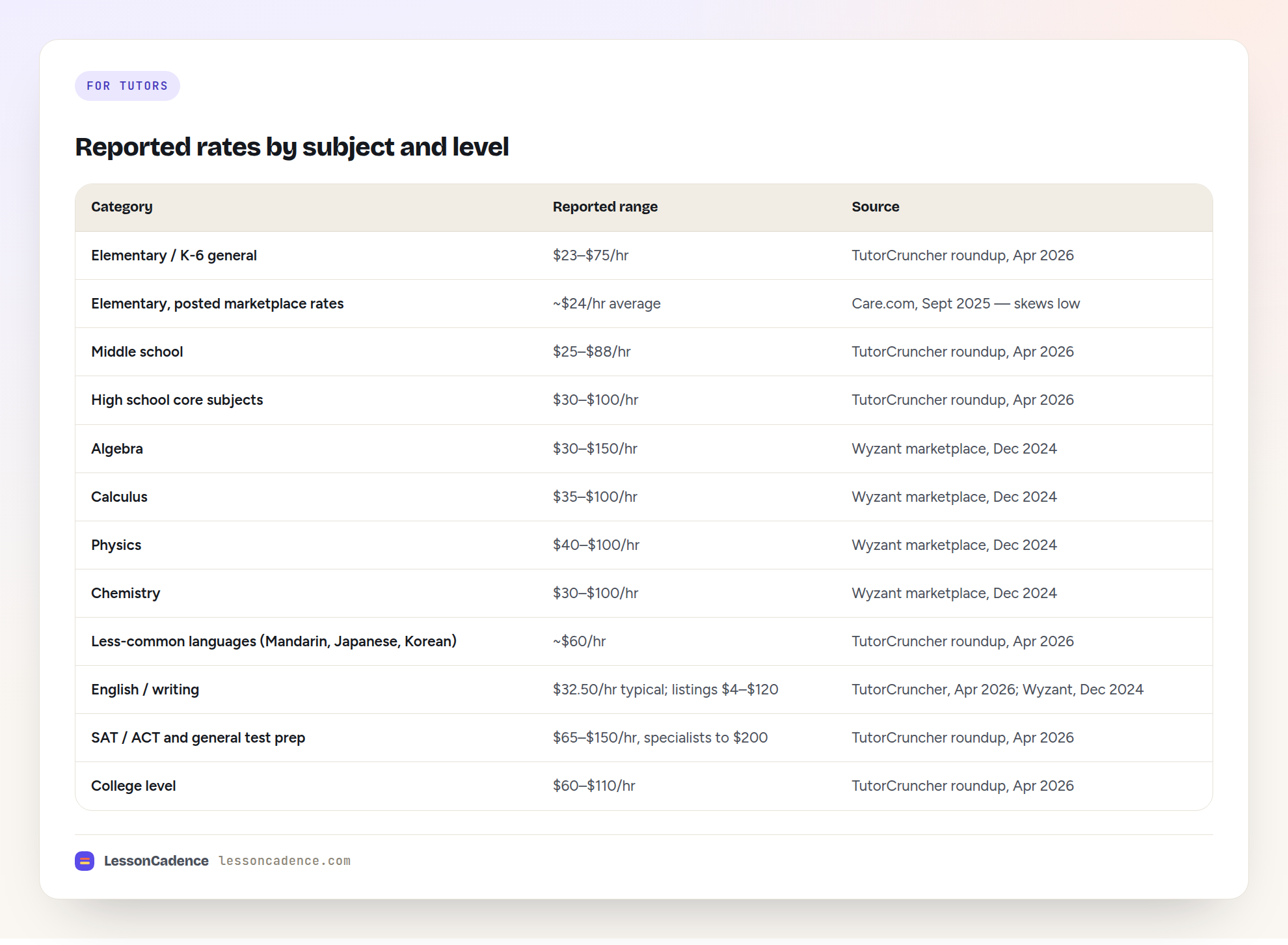
Here is every by-category figure worth citing, kept as its source reported it. Nothing here is averaged, blended or estimated by us.
| Category | Reported range | Source |
|---|---|---|
| Elementary / K-6 general | $23–$75/hr | TutorCruncher roundup, Apr 2026 |
| Elementary, posted marketplace rates | ~$24/hr average | Care.com, Sept 2025 — skews low |
| Middle school | $25–$88/hr | TutorCruncher roundup, Apr 2026 |
| High school core subjects | $30–$100/hr | TutorCruncher roundup, Apr 2026 |
| Algebra | $30–$150/hr | Wyzant marketplace, Dec 2024 |
| Calculus | $35–$100/hr | Wyzant marketplace, Dec 2024 |
| Physics | $40–$100/hr | Wyzant marketplace, Dec 2024 |
| Chemistry | $30–$100/hr | Wyzant marketplace, Dec 2024 |
| Less-common languages (Mandarin, Japanese, Korean) | ~$60/hr | TutorCruncher roundup, Apr 2026 |
| English / writing | $32.50/hr typical; listings $4–$120 | TutorCruncher, Apr 2026; Wyzant, Dec 2024 |
| SAT / ACT and general test prep | $65–$150/hr, specialists to $200 | TutorCruncher roundup, Apr 2026 |
| College level | $60–$110/hr | TutorCruncher roundup, Apr 2026 |
Two honest gaps. We found no citable dataset for executive-function or academic coaching rates. Practitioners we can see publicly price it alongside test prep rather than alongside homework help, because it is sold in multi-month blocks to families with a diagnosed problem, but there is no survey to point at. If someone quotes you a national average for it, ask where it came from.
And the marketplace rows are systematically low. Treat Care.com's $24 and Wyzant's list prices as the floor of the supply curve, not the middle of it.
Plenty of tutors also teach music, and the same six-step formula runs there with different inputs — see how much to charge for piano lessons for the music-side version.
The stakes principle: why test prep pays double
Look at the table again by ratio rather than by dollar. Elementary help sits around $24 to $30. Test-prep specialists sit at $65 to $150. That is a three- to five-fold gap, and it holds in every source above.
The subject is not what changed. The stakes did.
Three things push a session up the price ladder:
- A dated outcome. An SAT sitting is on a calendar. A parent cannot postpone the decision, cannot shop for six weeks, and will not haggle over $20 in March.
- Scarcity of supply. Almost anyone can help with third-grade reading. Far fewer people can teach AP Physics C well, and both of you know it.
- A consequence the family can name. "Passes the class," "gets into the program," "keeps the scholarship." When a parent can state the outcome in one sentence, the rate stops being compared to babysitting.
The practical move: stop describing your service by subject and start describing it by outcome. "Math tutoring" prices against the elementary floor. "AP Calculus AB, exam in May, targeting a 5" prices against the test-prep ceiling. Identical hour, different market.
Geography does move rates, but less than you would expect. Care.com's 15-city posted-rate spread was $18.86 in San Antonio to $26.21 in Seattle — about 39% between the cheapest and priciest metros in that dataset. The subject spread inside a single platform was five-fold.
Platform vs. independent: what a take rate really costs
This is the line item most tutors underestimate, and it is easy to price exactly.
Wyzant retains a 25% platform fee from the tutor's posted rate, and adds a 9% service fee on the family's side. Run one session at a $60 posted rate:
| Line | Amount |
|---|---|
| Posted rate | $60.00 |
| Family pays (rate + 9% service fee) | $65.40 |
| Wyzant platform fee (25% of posted rate) | −$15.00 |
| Tutor receives | $45.00 |
| Total gap between what the family pays and what you keep | $20.40 (31%) |
Now scale it. Fifteen sessions a week for 44 weeks is 660 sessions. At a $60 posted rate, the platform fee alone is $9,900 a year.
To net $60 an hour on that platform you have to post $80, and the family then pays $87.20. You are not cheaper than an independent tutor charging $80 direct. You are more expensive to the family and poorer yourself.
None of which means leave the platform. It means know what the platform is being paid for, and stop paying it for students it did not find. A marketplace is a customer-acquisition channel. Once a family has been with you for three months and refers their neighbor, you are paying an acquisition fee on a customer you already own.
The standard move is to keep the profile live for new leads, take referrals and word-of-mouth families direct, and price those two channels differently. Check your platform's terms first — most restrict taking an introduced student off-platform, and some restrict it permanently.
It also changes what your direct rate should be. If the platform nets you $45 on a $60 posting, then $60 direct is a raise for you and a discount for the family at the same time. That is the easiest rate conversation you will ever have, and most tutors never run the arithmetic that makes it possible.
In-person and online
Online tutoring prices lower in the data we can source: $25 to $60 an hour in TutorCruncher's roundup against $25 to $80 for private tutoring generally. Gitnux's aggregated figures put online at 45% of total US tutoring revenue.
Do not read that as "online is worth less." Read it as a different cost structure. Online removes travel, which is unpaid time you were absorbing, and it removes the geographic cap on who can hire you.
An in-person session that costs you 40 minutes of driving is really a 1-hour-40-minute job. At $70 an hour, that is an effective $42.
Price in-person to include the travel, or don't travel. A $15 to $25 travel surcharge inside a set radius is normal and easy to explain. A drive you eat silently is a rate cut you gave yourself.
Packages and retainers as a rate strategy
Selling a block — eight sessions, or a fixed weekly retainer through exam season — raises your effective rate two ways. It removes the weekly re-decision that produces cancellations, and it lets you charge for the outcome rather than the hour. Most tutors price a package at a small discount per session and still come out ahead on collected revenue, because the leakage disappears.
The full comparison, including where packages cost you money, is in the package vs. pay-per-session billing math, and the seasonal version in pricing SAT and ACT spring prep. One caveat while you plan: LessonCadence does not yet automate prepaid package credits — that is on the roadmap, so track blocks manually for now.
The bottom-up formula: price from your income, not from an average
Averages describe a market. They cannot tell you what you need. Do this instead.
Step 1 — Set your target take-home. The number you need to live on, after tax. Say $58,000.
Step 2 — Gross it up for tax. Self-employment tax alone is 15.3% (12.4% Social Security plus 2.9% Medicare), and federal and state income tax sit on top. A 28% reserve is a common working figure; your bracket is your own, and the tutor deduction checklist will change it. $58,000 ÷ 0.72 = $80,600.
Step 3 — Add business costs. Software, materials, insurance, mileage, a laptop amortized. Call it $3,000. Revenue needed: $83,600.
Step 4 — Count real billable weeks, not 52. Four weeks off, two holiday weeks, and a summer that runs thin. Forty-four full-load weeks is realistic for an academic-calendar tutor.
Step 5 — Count real sessions, not scheduled ones. At 25 sessions a week, 44 weeks is 1,100 scheduled. Assume 6% lost to no-shows and late cancels you never recover: 1,034 billed sessions.
Step 6 — Divide. $83,600 ÷ 1,034 = $80.85 an hour. Round up to $85.
| Step | Figure |
|---|---|
| Target take-home | $58,000 |
| ÷ 0.72 for tax reserve | $80,600 |
| + business costs | $83,600 |
| Scheduled sessions (25/wk × 44 wks) | 1,100 |
| − 6% leakage | 1,034 billed |
| Required rate | $85/hr |
Two things fall out of that arithmetic, and they matter more than the $85.
A full-time independent tutor lands above the "average" range. Every cost page in the search results tops out around $80. That range mostly describes part-time and platform supply — remember, 65% of US tutors work part-time by Gitnux's count. If you are supporting a household on this, the published average is not your peer group.
Leakage is a rate decision. Those 66 unrecovered sessions are $5,610 a year at $85. Cutting them in half is worth more than a $2 rate increase, and it is a policy problem, not a pricing one: a written cancellation window, applied the same way every time. (This is what a policy engine does automatically — LessonCadence checks the window at the moment of reschedule and charges or credits accordingly — but a clear policy and a calendar reminder recover most of it.)
Also note what is not in the formula: prep, marking, parent emails, invoicing and chasing payment. Those hours are real and unpaid, which is why 25 billable sessions is close to a full working week. Your rate has to carry them. If you want the awkward-money side of that solved too, see invoicing tutoring clients without the awkward text.
Does a degree or teaching license move your rate?
Honest answer: we found no citable dataset that isolates a credential premium in US tutoring rates. Vendor guides assert one. None of them show the data, so we are not going to repeat a number we cannot trace.
What the sourced data does show is where the money sits. Every top-of-range figure in the table above belongs to a subject that is hard to teach, hard to hire for, or attached to a dated exam. Wyzant's $150 algebra listings and its $30 algebra listings are the same credential market and a five-fold price gap.
The workable read: a credential rarely raises your rate on its own, but it is often what makes the high-stakes work available to you. A state license is what gets you the IEP-adjacent referral. A physics degree is what lets you say yes to AP Physics C. Buy the credential for the door it opens, not for the premium it supposedly prints.
When and how to raise your rate
Raise annually, on a fixed date, for everyone, announced in writing four to six weeks ahead. Ad-hoc raises for individual families are where the resentment lives.
The three signals it is overdue:
- You have a waitlist. Demand exceeds supply and price is the only lever left.
- Nobody has flinched in a year. If not one prospect has said "that's more than we expected," you are under market.
- Your best hours are full and your worst hours are empty. Raise the after-school block first. That is what a scarce slot is worth.
Move by 8% to 12% when you move. A $2 increase costs you goodwill for the same reason as a $10 one and buys a quarter of the revenue.
Run the number before you decide it is too aggressive. On the 1,034 billed sessions in the example above, going from $85 to $94 — an 11% move — is $9,306 a year. Losing one of the twenty-five weekly slots to that increase costs roughly 44 sessions, or $4,136. You are still about $5,000 ahead, and you have an open slot in a peak after-school hour that you can refill at the new rate.
Grandfather by date, not by family. "Current families keep the existing rate through December; the new rate starts in January" is fair and finite. "The Reyes family still pays 2023 prices because they've been with me forever" is a discount with no end date, and every other family eventually finds out about it.
What to actually say
The mistake is explaining. A rate change is an announcement, not a request, and long justifications invite negotiation. Three sentences is the whole email:
Starting January 5, my rate for one-hour sessions will be $94. I'm sending this now so you have plenty of time to plan, and your January invoice will reflect the new rate. Thank you for another great term — Priya's progress on the AP practice sections this fall has been real.
Notice what is missing. No apology, no mention of your own costs, no "I hope you understand." The one thing you do include is evidence that the work is worth it — a specific, named piece of progress. That is what a family is actually deciding about when they read the number.
If someone pushes back, the answer is a choice, not a discount: keep the hour at the new rate, move to 45-minute sessions to hold the monthly total, or drop to fortnightly. Offering options keeps the relationship and protects the rate. Cutting the rate for one family quietly resets it for everyone they talk to.
Frequently asked questions
How much do tutors charge per hour in 2026?
Most independent US tutors charge $25 to $80 an hour. Elementary and general homework help sits at the bottom, high-school core subjects in the middle, and college-level and test-prep work at $60 to $150. Marketplace-listed rates average lower — about $24 on Care.com — because a listed rate is an ask, not a transaction.
Is $50 an hour too much for a tutor?
No. Fifty dollars an hour sits mid-range for high-school core subjects across every dataset we checked, and below range for test prep, AP-level STEM or college work. If you are teaching an advanced or exam-dated subject and charging $50, you are almost certainly under market rather than over it.
How much do SAT tutors charge?
Test prep is reported at $65 to $150 an hour, with specialists in major cities reaching $200, against about $100 for the average posted starting rate on Care.com. It prices above core subjects because the exam date is fixed, the stakes are named, and qualified supply is thin in the peak spring season.
Should I charge more for in-person tutoring than online?
Usually yes, and the difference should equal your travel time. Online sessions are reported at $25 to $60 an hour against $25 to $80 for private tutoring generally. A 40-minute round trip turns a one-hour session into a 100-minute job, so add a travel surcharge inside a fixed radius or teach that slot online.
Do tutors make more independently or on a platform?
Independently, once the student exists. Wyzant retains 25% of a tutor's posted rate and adds a 9% family-side fee, so a $60 session pays you $45 while the family pays $65.40. Platforms earn their cut on students they find for you; on referrals and long-term families, that cut is pure margin loss.
Sources
- US Bureau of Labor Statistics, Occupational Employment and Wage Statistics, Table 1, Tutors (SOC 25-3041), May 2025 reference period — employment 175,070; median hourly wage $20.84; mean hourly wage $23.10. https://www.bls.gov/news.release/ocwage.t01.htm (checked 2026-09-30)
- US Bureau of Labor Statistics, OEWS frequently asked questions — "The survey does not cover the self-employed, owners and partners in unincorporated firms, household workers, or unpaid family workers." https://www.bls.gov/oes/oes_ques.htm (checked 2026-09-30)
- Gitnux, "US Tutoring Industry Statistics" (third-party aggregator) — ~1.2M active tutors; 85% freelance via platforms; 65% part-time; $35/hour average; online 45% of revenue. Page last verified by publisher June 20, 2026; underlying figures are 2023-dated. https://gitnux.org/us-tutoring-industry-statistics/ (checked 2026-09-30)
- Care.com, "How Much Does a Tutor Cost?" — average posted starting rates as of September 22, 2025: ~$24/hour K-12, $60 college, $100 test prep; 15-city range $18.86 (San Antonio) to $26.21 (Seattle). Marketplace-derived; skews low. https://www.care.com/c/how-much-does-a-tutor-cost/ (checked 2026-09-30)
- Wyzant blog, "How Much Does Tutoring Cost?" (updated December 23, 2024) — platform average $35–$60/hour across 65,000+ tutors; algebra $30–$150, calculus $35–$100, physics $40–$100, chemistry $30–$100, writing $4–$120. Marketplace-derived; skews low. https://blog.wyzant.com/how-much-does-tutoring-cost/ (checked 2026-09-30)
- Wyzant Help Center, "What is the fee structure for tutors listed on Wyzant?" — tutors retain 75% of the posted rate, Wyzant retains a 25% platform fee; a separate 9% service fee applies to all lessons. https://support.wyzant.com/tutors/tutor-payments/what-is-the-fee-structure-for-tutors-listed-on-wyzant/ (verified 2026-09-30)
- TutorCruncher, "Average Tutoring Rates USA" (published April 16, 2026) — elementary $23–$75, middle school $25–$88, high school $30–$100, college $60–$110; math $52.50, chemistry $75, English $32.50, Mandarin/Japanese/Korean $60; test prep $65–$150 with specialists to $200; online $25–$60. Vendor-compiled roundup drawing on BLS (2024), Care.com and Technavio; also states a private tutor costs roughly $25–$80 an hour. https://tutorcruncher.com/blog/average-tutoring-rates (checked 2026-09-30)
- Internal Revenue Service, "Self-Employment Tax (Social Security and Medicare Taxes)" — 15.3% total, comprising 12.4% Social Security and 2.9% Medicare; Schedule SE required at $400 net earnings. https://www.irs.gov/businesses/small-businesses-self-employed/self-employment-tax-social-security-and-medicare-taxes (checked 2026-09-30)
Written for teachers by the LessonCadence team. Last reviewed: 2026-09-30.