Music studio management software: a buyer's guide
Music studio management software replaces the stack most teachers already run — a scheduler, a notes doc, an invoicing tool, and a payment app — with one system where the lesson you taught becomes the invoice you send. A solo teacher should expect to pay $10–$30 a month (USD). The subscription is almost never the expensive part. The payment fees are.
The short version
- The seven jobs. Schedule, remind, note, assign, invoice, collect, report. Score every vendor on all seven, not on the feature list they lead with.
- Solo pricing clusters tightly. My Music Staff is $16.95/month. MakeMusic Studio (formerly Fons) lists $19.95/month. Teachworks starts at $16.49/month plus $0.32 per student lesson.
- The payment rail is where the money is. At 30 students billing $7,200 a month, the gap between the cheapest and most expensive option we priced is $887 a year. Half of that is the card rate, and at 90 students the card rate is nearly all of it.
- Two names changed this summer. Fons became MakeMusic Studio in June 2026, and Music Teacher's Helper became Duet Partner and now publishes pricing metered by student count, $14 to $49 a month.
- There is no single winner. Solo teachers and multi-teacher studios are buying two different products. The decision tree at the end sorts you.
What music studio management software does: the seven jobs
Feature lists are how vendors compare themselves. Jobs are how you should. Here are the seven a private studio actually needs done, in the order a lesson moves through them.
The useful test for each one is not "does the software have it," but "does it happen without me." A tool that lets you write a lesson note has done nothing for you if writing it is still a decision you make at 9pm.
1. Schedule. Recurring weekly slots, not one-off bookings. A teaching calendar is a repeating structure with term breaks, holidays, and the occasional swap — a meeting scheduler models none of that well.
2. Remind. Automated SMS or email before the lesson. This is the single cheapest no-show reduction available, and every serious vendor ships it.
3. Note. What happened in the lesson, written in under a minute, visible to the parent paying for it. Notes are the retention feature, not the admin feature.
4. Assign. Repertoire, exercises, and practice targets that a student can look up on Thursday when they've forgotten what you said on Monday.
5. Invoice. Bills generated from attendance that actually happened, reconciled against make-ups and credits. A tool that bills every student a flat amount regardless of the calendar just moves your reconciliation work to a different evening.
6. Collect. Auto-pay on a stored card or bank account, with dunning when it fails. This is the difference between getting paid on the 1st and chasing seven families on the 12th. If storing a family's card makes you uneasy, read how auto-pay for lesson billing actually works before you rule it out.
7. Report. Who owes what, who's slipping in attendance, what each teacher earned. You need this monthly, not daily.
Two jobs sit underneath all seven and get skipped in most roundups. Family accounts — one payer, several students, one invoice — matter the moment a household has siblings. And a cancellation policy engine — a rule that gets checked when the student cancels, not when you remember — is what turns a written policy into collected revenue.
Score every vendor on the same 12 questions
Run this on the free trial, not on the marketing site. Score each line 0 (no), 1 (partial or manual), or 2 (yes, automatic). Anything under 18 out of 24 will leak work back into your evenings.
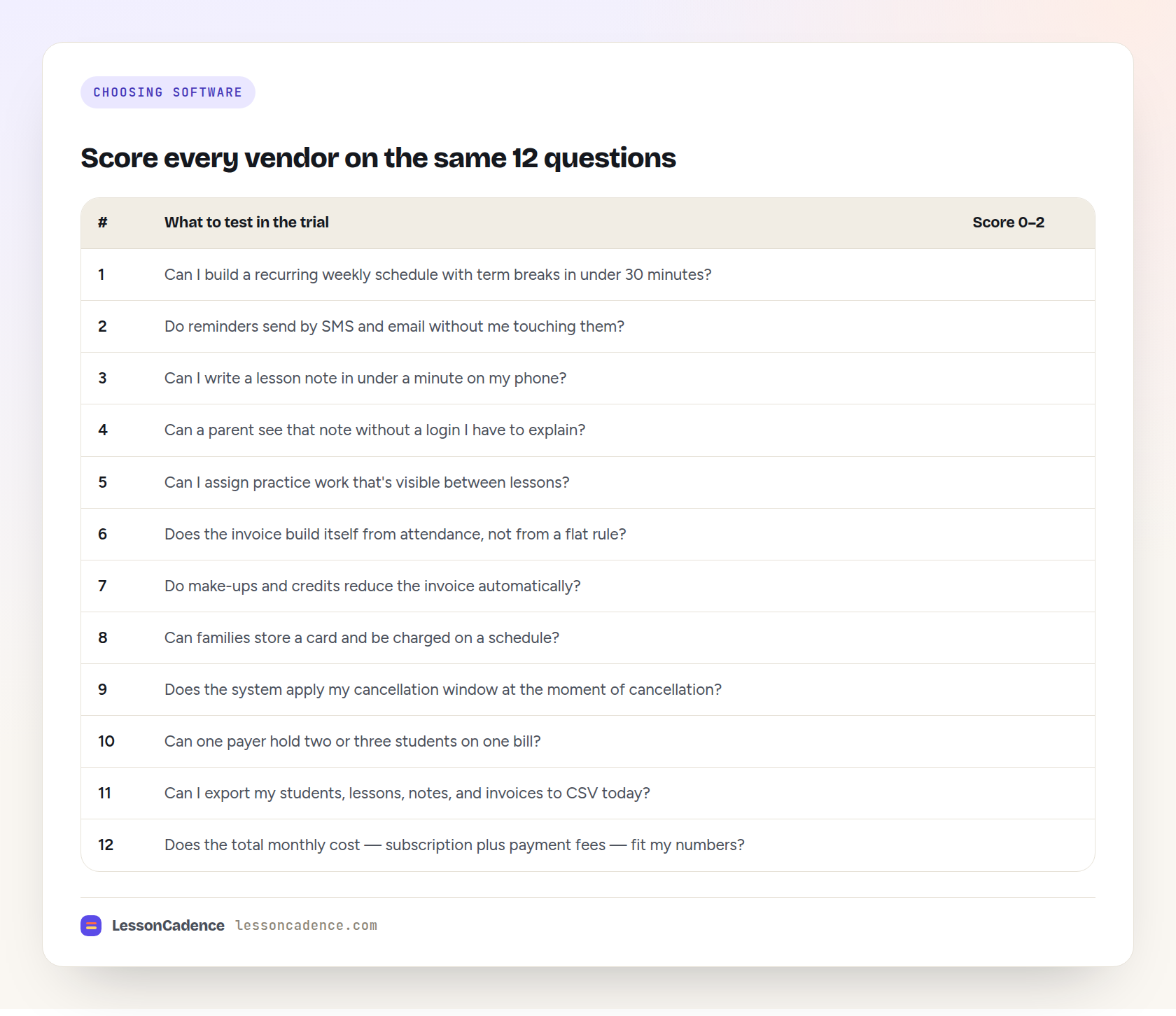
| # | What to test in the trial | Score 0–2 |
|---|---|---|
| 1 | Can I build a recurring weekly schedule with term breaks in under 30 minutes? | |
| 2 | Do reminders send by SMS and email without me touching them? | |
| 3 | Can I write a lesson note in under a minute on my phone? | |
| 4 | Can a parent see that note without a login I have to explain? | |
| 5 | Can I assign practice work that's visible between lessons? | |
| 6 | Does the invoice build itself from attendance, not from a flat rule? | |
| 7 | Do make-ups and credits reduce the invoice automatically? | |
| 8 | Can families store a card and be charged on a schedule? | |
| 9 | Does the system apply my cancellation window at the moment of cancellation? | |
| 10 | Can one payer hold two or three students on one bill? | |
| 11 | Can I export my students, lessons, notes, and invoices to CSV today? | |
| 12 | Does the total monthly cost — subscription plus payment fees — fit my numbers? |
The two lines teachers under-weight are 7 and 11. Make-up reconciliation is where monthly invoicing quietly loses money, and export is the only thing standing between you and a vendor you can never leave.
The five pricing models, and where each one bites
Almost every product in this category uses one of five models. They look similar at the demo and diverge sharply at scale.
Flat monthly. One price, unlimited students. My Music Staff ($16.95/month) and MakeMusic Studio ($19.95/month regular) both work this way. Predictable, and the model that rewards you for growing.
Flat plus per-teacher. The same, with an add-on per additional staff member. My Music Staff adds $4.95 per additional teacher or staff member; MakeMusic Studio adds $4.95 per additional staff member. Fine at three teachers, worth modeling at ten.
Per-student tiers. A flat price that steps up with roster size. Duet Partner (formerly Music Teacher's Helper) is $14/month for 1–20 students, $22 for 21–40, $38 for 41–100 and $49 for 101+. Cheap while you're small; the bill jumps the day you enroll the 21st student, and again at the 41st.
Per-lesson metering. A low base plus a charge per student lesson. Teachworks' Starter tier is $16.49/month plus $0.32 per student lesson. The trap is that this bills you more in your best months — a busy term or a summer intensive raises your software bill exactly when you're teaching hardest.
Card-fee take rate. A subscription plus a percentage of every payment collected. TutorCruncher's Pay as you go tier is $30/month with card payments at 3.85% for US companies; its Startup tier is $80/month at 3.5%. Compare that to Stripe's standard published US rate of 2.9% + 30¢ and the spread is the platform's cut. This is the model that scales with your revenue rather than your headcount, and it is the one to model before signing.
There's a sixth cost nobody prints on a pricing page: the processing fee on whatever rail you use. Vendors that let you connect your own Stripe account pass those rates through unchanged.
What 30 students actually costs
Assumptions, so you can re-run this with your own numbers: 30 students, one teacher, weekly lessons at $60, four lessons per student per month. That's 120 lessons and $7,200 of monthly billing, collected as 25 family charges (some households have siblings).
At Stripe's standard published US card rate, 2.9% of $7,200 is $208.80, plus 25 transactions at 30¢ is $7.50 — $216.30 a month in card fees before any software cost at all.
Now add the software. Where a vendor doesn't publish its own processing rate, this models pass-through at that same Stripe standard rate, and the table says so.
| Option (tier) | Software/month | Payment cost/month | Total/year |
|---|---|---|---|
| My Music Staff | $16.95 | $216.30 (pass-through) | $2,799 |
| Duet Partner (Plus, 21–40 students) | $22.00 | $216.30 (rate not published; modeled as pass-through) | $2,860 |
| MakeMusic Studio (Fons) | $19.95 | $245.10 (2.9% + 30¢ + 0.4% subscription volume) | $3,181 |
| Teachworks Starter | $54.89 ($16.49 + 120 × $0.32) | $216.30 (pass-through) | $3,254 |
| TutorCruncher Pay as you go | $30.00 | $277.20 (3.85%) | $3,686 |
| LessonCadence Solo | $18.00 | $216.30 (pass-through) | $2,812 |
Three things fall out of this table.
The subscription is close to noise. The whole spread between the cheapest and most expensive subscription here is about $38 a month, or $455 a year. The spread in total cost is $887 a year, and the card rate accounts for the other half. Double the roster and the card rate becomes nearly all of it.
Metering compounds. Teachworks' Starter tier costs $38.40 a month in per-lesson charges at 120 lessons. At 240 lessons a month, Starter and Growth cost the same; below that, Starter is cheaper. If you're a solo teacher, run the crossover before you upgrade — the higher tier isn't automatically the better deal.
ACH is the biggest single lever, and it's free to pull. Stripe's published ACH direct debit rate is 0.8% capped at $5. On a $288 average family charge that's $2.30 instead of $8.65 on a card. Across 25 families that's about $158 a month, or roughly $1,900 a year — more than any software decision on this page. If your platform supports bank debit, offer it and make it the default.
What three teachers and 90 students costs
The models re-rank as soon as you add staff. Same assumptions, scaled: three teachers, 90 students, 360 lessons a month, $21,600 billed, 72 family charges. Card pass-through at Stripe standard is $648 a month.
| Option (tier) | Software/month | Payment cost/month | Total/year |
|---|---|---|---|
| My Music Staff | $26.85 ($16.95 + 2 × $4.95) | $648.00 (pass-through) | $8,098 |
| Duet Partner (Premium, 41–100 students) | $38.00 | $648.00 (rate not published; modeled as pass-through) | $8,232 |
| LessonCadence Studio | $59.00 (up to 5 teachers) | $648.00 (pass-through) | $8,484 |
| Teachworks Growth | $116.03 ($47.99 + 360 × $0.189) | $648.00 (pass-through) | $9,168 |
| MakeMusic Studio (Fons) | $29.85 ($19.95 + 2 × $4.95) | $734.40 (incl. 0.4% subscription volume) | $9,171 |
| TutorCruncher Startup | $80.00 | $756.00 (3.5%) | $10,032 |
My Music Staff is the cheapest option on this page at three teachers, with Duet Partner $134 a year behind it. Per-teacher add-ons of $4.95 stay cheap for a long time, and Duet's tier holds flat until the 101st student. That's the honest read, and it's why the decision tree below sends music-only studios to My Music Staff first.
Notice also that Teachworks flips tiers between the two examples. At 120 lessons Starter wins; at 360 lessons Growth is $15 a month cheaper. Metered pricing means the right tier changes as your term changes, so re-check it in September and again in January.
The costs that aren't on the pricing page
Four line items regularly turn a $20 plan into a $60 one. Ask about each in the trial.
SMS credits. Text reminders are the highest-value automation in the category and they are frequently metered separately. SimplyBook.me, for example, sells SMS credits and a custom domain as separate add-ons on top of the plan price.
Branches and locations. Teachworks includes the first five branch accounts on Premium and charges $35/month per additional branch. TutorCruncher charges $50/month per extra branch.
Domains and support. TutorCruncher lists a custom domain at $100/month and extended priority support at $120/month. If those are on your must-have list, they roughly double the Startup tier.
Payment surcharges. International cards and premium cards cost more almost everywhere: TutorCruncher adds 1.5% and 2% respectively, and Stripe adds 1.5% for international cards. If a chunk of your families pay with Amex, model it.
The main options, compared
Disclosure: LessonCadence is our product, and it is pre-launch as this is written — what follows describes the product built and tested for launch, at launch prices. It's in the table because leaving it out would be coy, and it's described the same way as everything else — by what it does today, with pricing you can check. Where an incumbent is better, this guide says so.
Feature rows below come from each vendor's own pricing, feature, and help-center pages as of September 10, 2026. Where a vendor doesn't document a capability publicly, the table says "not documented" rather than guessing.
The lesson
| Product | Scheduling | Lesson notes | Practice assignments | Serves |
|---|---|---|---|---|
| My Music Staff | Yes | Yes | Yes (files, LMS) | Music only |
| MakeMusic Studio (Fons) | Yes | Yes | Not documented | Music only |
| Duet Partner (was Music Teacher's Helper) | Yes | Yes | Yes (practice log) | Music only |
| Teachworks | Yes | Yes (student records) | Not documented | Multi-vertical |
| TutorCruncher | Yes | Yes | Partial | Tutoring only |
| SimplyBook.me | Yes (core) | No | No | Any business |
| Calendly | Yes (core) | No | No | Any business |
| LessonCadence | Yes | Yes | Yes | Music + tutoring |
The money
| Product | Recurring invoicing | Embedded auto-pay | Published payment rate |
|---|---|---|---|
| My Music Staff | Yes | Yes | Not published |
| MakeMusic Studio (Fons) | Yes | Yes | 2.9% + 30¢; ACH 1.8%; +0.4% subscription volume |
| Duet Partner | Yes | Yes (card, bank, PayPal) | Not published |
| Teachworks | Yes | Via integrations | Not published |
| TutorCruncher | Yes | Yes | 3.85% (PAYG) / 3.5% (Startup) |
| SimplyBook.me | Add-on | Add-on | No transaction fees on plans |
| Calendly | No | No (routing only) | n/a |
| LessonCadence | Yes (from attendance) | Yes | Card pass-through; optional 1% |
The studio
| Product | Cancellation policy engine | Family accounts | Multi-teacher / payroll | Published price |
|---|---|---|---|---|
| My Music Staff | Yes (cancel deadline, auto-bill) | Yes | Yes (payroll) | $16.95/mo + $4.95/teacher |
| MakeMusic Studio (Fons) | Yes (hour window, auto-charge) | Yes | Yes | $19.95/mo + $4.95/staff |
| Duet Partner | Not documented | Partial (billing profiles) | Not documented | $14–$49/mo by student count |
| Teachworks | Not documented | Yes | Yes (payroll) | $16.49/mo + $0.32/lesson |
| TutorCruncher | Partial | Yes | Yes | $30 / $80 / $240 per mo |
| SimplyBook.me | No | No | No | Free–$49.90/mo (annual) |
| Calendly | Partial (booking limits) | No | Seat-based | Free–$20/seat/mo ($16 annual) |
| LessonCadence | Yes (checked at reschedule) | Yes | Yes (payroll splits) | $18/mo solo; $59/mo studio |
What each one is genuinely good at
My Music Staff is the default for private music studios for good reasons. One flat $16.95/month covers unlimited students, and the feature set is broad — scheduling and attendance, invoicing and payments, a parent and student portal, a drag-and-drop studio website builder, payroll, expense and mileage tracking. It ships a real Studio Cancellation Policy: set a cancel deadline, and a late cancellation is automatically marked "Absent, No Make-Up" and billed, with teacher override. It offers a 30-day trial and a 90-day money-back guarantee. If you teach only music and want the safest choice, start here — and read our full My Music Staff pricing and review breakdown before you commit.
MakeMusic Studio is Fons, renamed in June 2026 after MakeMusic's acquisition. Same platform, same logins, plus a built-in recorded music library with interactive sheet music. Its billing engine is the standout — flat-rate and per-appointment subscription billing, prorating, and a cancellation policy set in hours with automatic charging. It is the only vendor here that publishes its full processing schedule on the pricing page, which is a genuine mark of good faith: 2.9% + 30¢ on cards, 1.8% ACH, plus 0.4% of subscription volume. Note that last line when you model costs.
Duet Partner is Music Teacher's Helper under a new name — the longest-tenured brand in the category, with a 14-day no-card trial. It now publishes its pricing, metered by roster size: $14/month for 1–20 students, $22 for 21–40, $38 for 41–100 and $49 for 101+. Under 20 students it is the cheapest paid tool on this page. Its pages document a practice log, assigned repertoire, billing profiles and automated payments by card, bank transfer or PayPal, but not an automatic late-cancellation charge, a consolidated family invoice, or multi-teacher studios. If you need any of those, ask before the trial ends rather than assuming.
Teachworks is the multi-vertical option: tutoring centers, language schools, test prep, music schools, driving schools. Unlimited students, teachers, and user accounts on every tier, with API access from Growth up and branch accounts on Premium. If you run a school with rooms, staff hours, and payroll, its depth is real. The per-lesson metering fits organizations that think in volume, less so a solo teacher with a good term.
TutorCruncher is built for tutoring agencies and franchises — branches, white-label domains, tutor management, and serious operational depth. If you're placing tutors with clients and taking a margin, it does things nothing else here does. Its card fees are the highest published in this group (3.85% or 3.5%, plus 1.5% on international cards and 2% on Amex, Diners, JCB, UnionPay and prepaid), and it does not address music teaching.
SimplyBook.me and Calendly are excellent at the one job they claim. Calendly's free tier and near-universal familiarity make it the frictionless choice for booking; SimplyBook.me adds a booking website, a free tier at 50 bookings a month, and no transaction fees on its plans. Neither models a lesson, a note, a family, or an invoice from attendance. They are a fine starting point and a predictable ceiling — see how the scheduling-only tools compare for teaching studios.
LessonCadence — ours — is built on a single lesson object that carries schedule, notes, practice assignments, invoice, and payment through one record, for music teachers and academic tutors in the same account. Recurring invoices generate from actual attendance and reconcile make-up credits from a ledger; the cancellation policy is checked at the moment a family reschedules; family accounts, a parent portal, and multi-teacher payroll splits are live. Solo is $18/month, Studio is $59/month for up to five teachers. Payments run at card pass-through, with an optional 1% convenience fee for instant payout and automatic dunning. Where we are not the answer: if you teach only music, want a studio website builder today, and three teachers, My Music Staff is cheaper and more mature.
One claim you'll read elsewhere, and shouldn't believe: that the music-only incumbents can't enforce a cancellation policy. Checking their own documentation, both My Music Staff and MakeMusic Studio enforce a real notice window with automatic billing. Policy enforcement is not a differentiator in music-only tools. What differs is what happens next — how the resulting credits are tracked, and whether they reconcile onto the invoice without you.
Solo teacher vs. multi-teacher studio
These are two different purchases and the same table can't decide both.
A solo teacher is buying back evenings. The binding constraints are total monthly cost, how fast notes can be written on a phone, and whether auto-pay actually ends the payment chase. Multi-teacher features are dead weight you'll pay for anyway. Flat pricing suits you; per-lesson metering rarely does.
A multi-teacher studio owner is buying a system that runs without them. The binding constraints are per-teacher calendars, permission boundaries so a teacher sees their students and not the studio's books, payroll or split reporting that matches how you actually pay staff, and one parent-facing brand. Model the per-teacher cost at your headcount plus two, because adding a teacher is the moment pricing bites.
The order of operations differs too. A solo teacher can switch tools in a weekend. A studio with six teachers and 180 families should migrate between terms, with a written cutover date and one month of parallel running on billing.
There's a third case worth naming, because no vendor page addresses it: the teacher who does both. Piano students in the afternoon, SAT or math students in the evening, one household calendar, one tax return. Today that usually means two subscriptions and two invoicing systems, because the music tools don't model an academic session and the tutoring tools don't model repertoire. If that's you, the deciding question is whether one account can hold both kinds of lesson — and most of the products on this page answer no.
Before you commit: five things to check
Data export. Ask for a CSV of students, lessons, notes, and invoices during the trial — and actually download it. A vendor that can't export your lesson notes owns your studio history. This is the single most-skipped check in the category.
Migration help. Moving 40 families by hand is a lost weekend. Ask specifically whether the vendor imports students, recurring schedules, and outstanding balances, and whether a person does it or you do.
Contract length and refunds. Trials range from 14 to 30 days here. Prefer month-to-month while you're still learning what you need; annual discounts are worth taking only after a full billing cycle has run clean.
Support during your teaching hours. Billing problems surface at 6pm on the 1st. Check the published support hours against your time zone, and email a real question during the trial to see how long the reply takes.
Who owns the payment relationship. There's a real difference between a platform that connects your own Stripe account and one that processes on its own merchant account. The first means your payout schedule, your dispute process, and your rates travel with you if you leave. The second usually means a smoother setup and a harder exit. Neither is wrong — but know which one you're signing up for, because it's the part of a migration that actually hurts.
Which should you pick
A short decision tree. Read down until one fits.
- You teach music only, solo, and want the safest broad choice → My Music Staff.
- You teach music only and billing automation is your pain → MakeMusic Studio, and model the 0.4% subscription-volume fee.
- You run a school with rooms, staff hours, and branches → Teachworks.
- You run a tutoring agency placing tutors with clients → TutorCruncher, with the card-fee math done first.
- You need booking and nothing else, this month → Calendly or SimplyBook.me, knowing you'll outgrow it.
- You teach both music and academic subjects, or you want the policy, credits, and invoicing to run themselves → LessonCadence.
- You're still not sure → pick the two closest, run the 12-question checklist on both trials in the same week, and let the scores decide.
Whatever you choose, the deciding number is total annual cost including payment fees — not the price on the pricing page. For the wider category view, see our roundups of the best music teacher software and the best studio management software for 2027.
FAQ
How much does music studio management software cost?
For a solo music teacher, $10–$30 a month covers the main options: Duet Partner from $14/month for up to 20 students, My Music Staff at $16.95/month, MakeMusic Studio at $19.95/month, Teachworks from $16.49/month plus $0.32 per student lesson. Multi-teacher studios pay per teacher (around $4.95–$6 each) or per lesson. Payment processing is extra and usually costs more than the subscription.
What is the best software for private music teachers?
There isn't one best answer, because solo teachers and multi-teacher studios buy different things. My Music Staff is the broadest music-only choice at a flat rate. Teachworks fits schools with staff hours and branches. Score two shortlisted vendors on the same 12 trial questions and pick the higher total.
Do I need studio software if I only have 15 students?
Probably yes, but for the collection, not the scheduling. Fifteen students still means 15 monthly invoices, reconciled make-ups, and a payment chase. At $18–$20 a month, one recovered late cancellation usually covers the cost. Paper works fine for scheduling; it does not work for auto-pay.
Can Calendly work for music lessons?
For booking, yes. Calendly's free tier handles one event type and a single calendar connection, and its paid Standard plan is $12/seat/month, or $10 billed annually. It has no lesson notes, no practice assignments, no invoicing from attendance, no family accounts, and no cancellation policy that charges. Most teachers end up stitching it to three other tools.
Does My Music Staff charge extra for additional teachers?
Yes. My Music Staff's published price is $16.95/month plus $4.95 per additional teacher or staff member, with unlimited students on every account. A five-teacher studio therefore pays $16.95 plus four × $4.95, or $36.75 a month, before payment processing.
Sources
All competitor pricing was verified against the vendor's own pricing page on the date shown, except where labeled third-party.
- My Music Staff — Pricing: $16.95/month, $4.95 per additional teacher or staff member, unlimited students, 30-day free trial, 90-day money-back guarantee. https://www.mymusicstaff.com/pricing/ (verified 2026-09-10)
- My Music Staff — Features (scheduling, invoicing and payments, student/parent portal, website builder, payroll, expenses and mileage). https://www.mymusicstaff.com/features/ (verified 2026-09-10)
- My Music Staff — Studio Cancellation Policy feature (cancel deadline; late cancels set to "Absent, No Make-Up" and billed; teacher override). https://www.mymusicstaff.com/new-studio-cancellation-policy-feature/ (verified 2026-09-10)
- MakeMusic Studio — Pricing: $19.95/month regular ($9.95 summer sale at time of checking), $4.95/month per additional staff, unlimited students, 14-day trial; processing 2.9% + $0.30 card, +1% international, 1.8% ACH, 0.4% of subscription volume. https://www.studio.makemusic.com/pricing (verified 2026-09-10)
- MakeMusic Studio — "Fons Is Now MakeMusic Studio," published June 21, 2026; rebrand only, subscription rates unchanged. https://www.studio.makemusic.com/blog/fons-is-now-makemusic-studio/ (verified 2026-09-10)
- MakeMusic Studio Help Center — cancellation policy set in hours, automatic charging on late cancels. https://help.studio.makemusic.com/en/articles/2060027-setup-my-cancellation-policy-on-makemusic-studio-and-avoid-last-minute-cancellations (verified 2026-09-10)
- Duet Partner (formerly Music Teacher's Helper) — Pricing: Basic $14/mo (1–20 students), Plus $22 (21–40), Premium $38 (41–100), Unlimited $49 (101+); 14-day trial, no card. https://www.musicteachershelper.com/pricing (verified 2026-09-10)
- Duet Partner — Features (calendar, practice log, assigned repertoire, billing profiles, automated payments by PayPal, bank transfer or card). https://www.musicteachershelper.com/features (verified 2026-09-10)
- Teachworks — Pricing: Starter $16.49/mo + $0.32 per student lesson; Growth $47.99/mo + $0.189; Premium $187.99/mo + $0.065 with first 5 branch accounts and $35/mo per additional branch; 21-day free trial; unlimited students, teachers and user accounts. https://www.teachworks.com/pricing (verified 2026-09-10)
- Teachworks — Home page feature and vertical claims (scheduling, student records, invoicing and online payments, payroll, reminders, analytics; tutoring, language, test prep, music and driving schools). https://www.teachworks.com/ (verified 2026-09-10)
- TutorCruncher — Pricing (US): Pay as you go $30/mo at 3.85% cards; Startup $80/mo at 3.5%; Enterprise $240/mo; +1.5% international cards; +2% Amex/Diners/JCB; extra branch $50/mo; custom domain $100/mo. https://tutorcruncher.com/pricing/us (verified 2026-09-10)
- TutorCruncher Help Centre — Stripe fees, US companies 3.85% (PAYG) and 3.5% (Startup); +1.5% international; +2% premium cards; +0.15% split payments. https://help.tutorcruncher.com/en/articles/14182785-stripe-fees (verified 2026-09-10)
- SimplyBook.me — Pricing: Free (50 bookings/mo), Basic $11.90 annual / $13.90 monthly, Standard $24.90 / $29.90, Premium $49.90 / $59.90, Enterprise custom; "no transaction fees"; 14-day trial. https://simplybook.me/en/pricing (verified 2026-09-10)
- Calendly — Pricing: Free (one event type, one calendar connection), Standard $12/seat/mo ($10 billed annually), Teams $20/seat/mo ($16 annually), Enterprise from $15k/yr. https://calendly.com/pricing (verified 2026-09-10)
- Stripe — Pricing: 2.9% + 30¢ per successful domestic card charge; +1.5% international; ACH direct debit 0.8% capped at $5.00. https://stripe.com/pricing (verified 2026-09-10)
Prices change. If you're reading this months after the review date below, re-check the vendor's own page before you decide.
Written for teachers by the LessonCadence team. Last reviewed: 2026-09-10.